
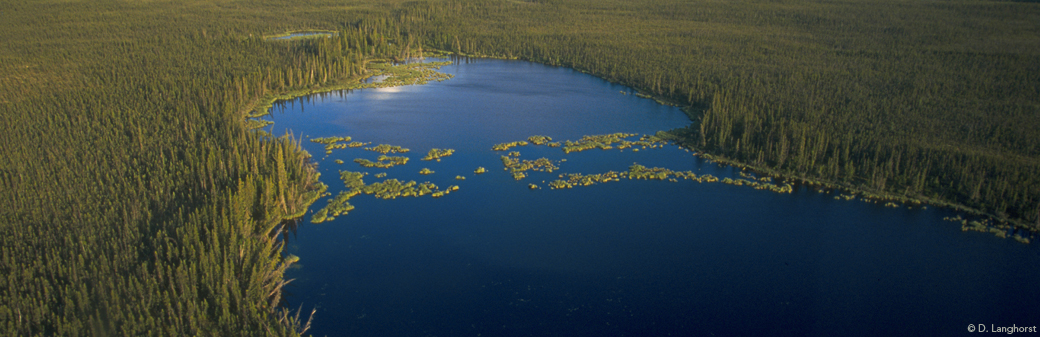
Conservation Values of the Boreal Forest
From billions of birds to the last remaining healthy populations of iconic large mammals, the North American Boreal Forest is teeming with wildlife. It also stores astounding quantities of carbon in its trees, peat, and soils, helping to slow the exacerbation of climate change. It can be thought of as a 'forest of blue' due to its remarkable networks of pristine lakes and rivers, which make it the largest source of unfrozen fresh water on Earth. These and other ecosystem values have been estimated to provide the equivalent of $700 billion in free, natural services each year.
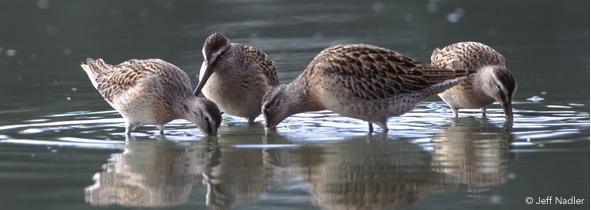
The boreal forest is incredibly important for maintaining North America's bird life. Between 1 to 3 billion migratory birds flock there each spring to nest and raise their young over the course of summer. Once the young are ready for flight, 3 to 5 billion (adults and young) take to the skies once more to return to their favored wintering grounds. More than 1 billion of these birds will eventually end up in the United States, while the remainder can be found from Mexico and the Caribbean all the way down to the southern tip of South America.
In all, 325 species of bird rely on the boreal forest for their survival—this amounts to nearly half of the species commonly found in the entire United States and Canada. The diversity of birds reliant on the boreal is equally impressive. Warblers, finches, and sparrows make up some of the most heavily reliant songbirds, while the vast quantity of lakes and rivers throughout the forest make it a critical region for numerous species of waterfowl and shorebirds. In fact, 80% of all waterfowl species found in North America depend upon the boreal forest for nesting habitat. Numerous raptors (eagles, hawks, owls) are also drawn to the bounty of food and resources the boreal provides each summer.
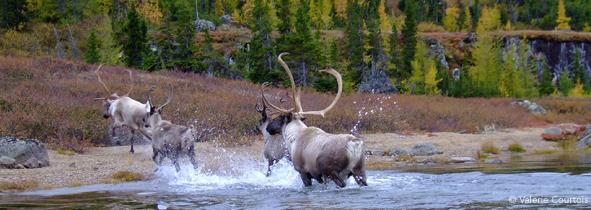
Large mammals have been some of the species hardest hit by the expanding footprint of human development around the world. However, the still mostly intact North American Boreal Forest has provided refuge for some of the continent's most iconic large mammals, many of which have lost considerable habitat further south. Moose, elk, and caribou still roam freely throughout the vast expanses of rugged boreal wilderness. Predators such as wolf, cougar, wolverine, and grizzly, black, and polar bears capitalize on the abundance of fish and other wildlife present in the boreal.
Smaller mammals such as beaver, otter, muskrat, and mink thrive in the lush wetlands, lakes, and waterways that course through the boreal forest. These waterways also produce some of the world's largest and healthiest populations of both freshwater and migratory fish. Atlantic salmon, chum salmon, sea-run brook trout, Arctic char, and others flow in and out of healthy boreal rivers, while Arctic grayling, lake trout, brook trout, pike, and walleye all flourish in the pristine lakes and rivers throughout the boreal.
One of the boreal forest's most critical and direct global contributions is its astounding ability to sequester and store carbon. Rising levels of carbon dioxide in the atmosphere is intensifying and speeding up climate change, but forests like the boreal are doing all they can to curb rising global temperatures and extreme weather. When left undisturbed, boreal forests slowly pull carbon dioxide out of the atmosphere and store it in trees and underlying peat and soils. Keeping this carbon locked in plant matter and in the ground is crucial in the fight against climate change.
Overall, boreal forests store nearly twice as much carbon as tropical forests worldwide. The Canadian Boreal alone stores 208 billion tonnes of carbon—equivalent to more than 1,000 years' worth of Canada’s GHG emissions in CO2 equivalent at 2014 levels. The boreal forest also offers a potential refuge for species that find their more southern habitat being altered by climate change; many species are expected to be pushed further north as global temperatures rise.
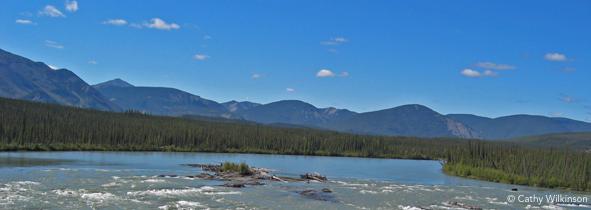
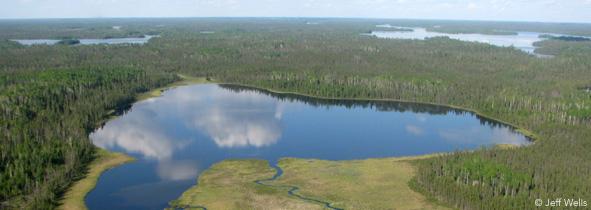
As much of the world struggles to maintain healthy and abundant waterways, the boreal forest could not be further from this issue. The retreat of the last ice age left the boreal speckled with millions of lakes and small ponds connected through intricate networks of pristine rivers and wetland networks. The Canadian Boreal Forest contains nearly 200 million acres of surface fresh water alone, larger than most countries on Earth. Even more impressive is the fact that the majority of this water is still unaltered, uncontaminated, and in relatively pristine condition.
In fact, this abundance of water makes the North American Boreal the largest source of surface fresh water on Earth. The Canadian Boreal houses 4 of the world's 10 largest lakes and 5 of the world's 50 largest rivers. It also contains the greatest number of large undammed, free-flowing rivers in all of North America. Equally impressive, the Canadian Boreal features 25% of the world's wetlands, which are extremely productive in terms of storing carbon, filtering contaminants out of water, and supporting surrounding wildlife.
Tour Canada's Boreal Forest
In just three minutes, get a nonstop, coast-to-coast, interactive experience with the earth's “green halo,” the boreal forest.
Cool Biodiversity Hotspots
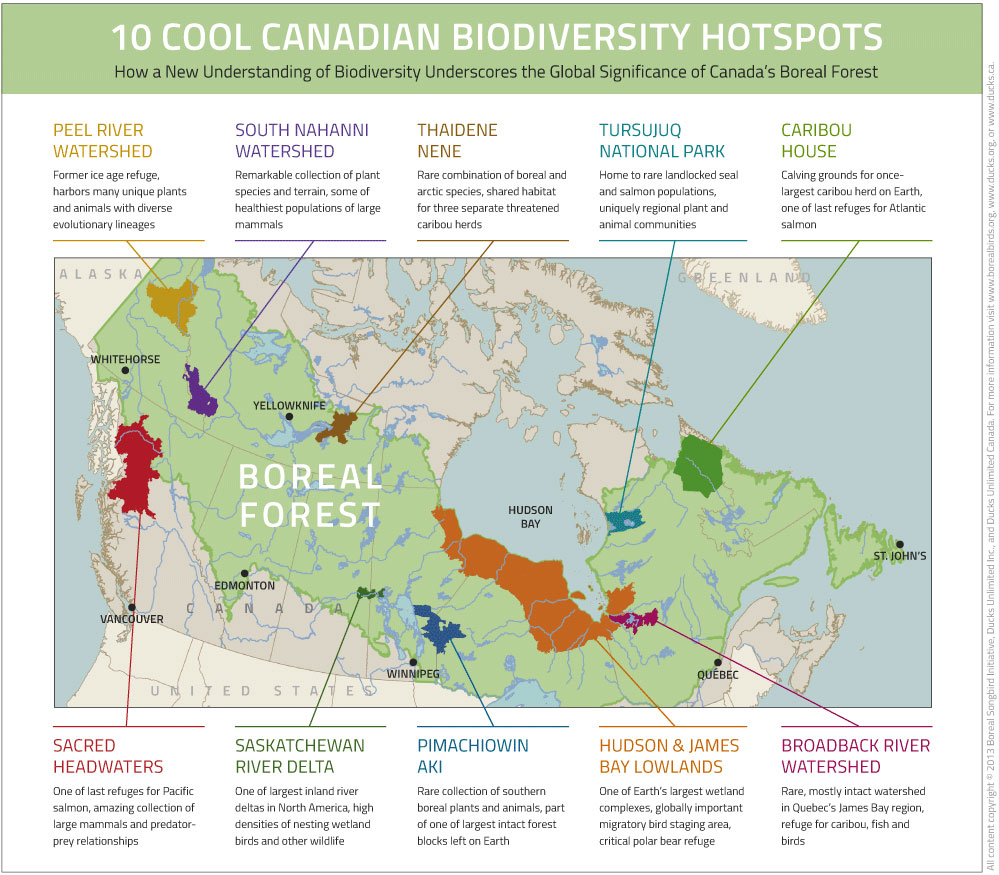
Biodiversity reaches far beyond the tropics. Learn why Canada's boreal forest is crucial to global biodiversity.
The 50/50 Approach
The best way to protect these conservation values and the many other values of the boreal forest is to protect half of the forest and to ensure that industrial activities undertaken in the remaining areas are carried out according to the highest global sustainability standards. Find out about the 50/50 approach »