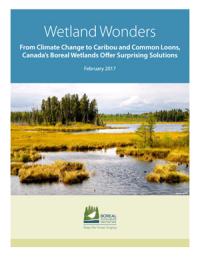
Boreal Songbird Initiative : Reports & Other Publications
SEARCH SITE 


Boreal forests important carbon repositories

Hanneke Brooymans
December 7, 2007
EDMONTON - A new series of maps shows how Canada's boreal forest manages to lock up almost twice as much carbon per unit area as the tropical forests.

The three maps show where permafrost, peatlands and soil with organic carbon are located within the boreal forest that covers much of the country. Each is adept at storing carbon, the basis for the planet's climate change problem.

This forest is to carbon what Fort Knox is to gold, said a senior scientist with the International Boreal Conservation Campaign.

"It's an internationally important repository for carbon, built up over thousands of years," said Jeff Wells in a statement. "The maps released today document where and how these vital carbon reserves are distributed across Canada. We should do everything we can to ensure that the carbon in this storehouse is conserved."

The maps were developed for the campaign by Global Forest Watch, an international forest conservation group with a Canadian chapter based in Edmonton.

Canada's boreal forest stores an estimated 186 billion tons of carbon in its widespread forest and peatland ecosystems-the equivalent of 27 years' worth of global carbon emissions from the burning of fossil fuels.

Globally, the boreal forest houses 22 per cent of the total carbon stored on the world's land surface. This is largely because in boreal climates, the colder temperatures reduce decomposition rates, resulting in deep organic soils that are thousands of years old, according to Wells.

University of Alberta ecologist David Schindler, who was involved with the mapping project, said Canada needs to be very careful about how it handles its forests if it wants to prevent more carbon from adding to the current climate change problem.

A study about five years ago suggested the boreal forest had been tipped from a slight sink that absorbed carbon to a slight source because of harvesting and fire, Schindler said.

Timber harvesting and controlling fire will be key strategies to keep the forest sequestering carbon, he added.

"Clearly, one thing we don't want to do given the size of this inventory is to accelerate the rate of carbon loss from it. We could easily double the emissions from this country to the atmosphere if we start doing things that could promote big forest fires. And there, I'd say number one is climate warming. We can already see some of the nasty surprises that weren't predicted like mountain pine beetle and spruce beetle outbreaks."

Schindler suggested that now is an opportune time to focus on keeping forests intact and putting them in long-term reserves, given the floundering economics of the forestry industry.

That's exactly what the federal government did about two weeks ago, when it announced protection for 25 million acres of new land in the Northwest Territories. Conservation groups lauded the decision as an example of "the type of action required to protect this critical carbon storehouse."
Banner photo credit: Northern Images, by Wayne Sawchuck
Jennings Lake in northern BC


FAIR USE NOTICE:
This site contains copyrighted material the use of which has not always been specifically authorized by the copyright owner. We are making such material available in our efforts to advance understanding of issues of environmental and humanitarian significance. We believe this constitutes a 'fair use' of any such copyrighted material as provided for in section 107 of the US Copyright Law. In accordance with Title 17 U.S.C. Section 107, the material on this site is distributed without profit to those who have expressed a prior interest in receiving the included information for research and educational purposes. For more information go to: http://www.law.cornell.edu/uscode/17/107.shtml. If you wish to use copyrighted material from this site for purposes of your own that go beyond 'fair use', you must obtain permission from the copyright owner.


info@borealbirds.org | 206.956.9040 | Newsletter UnsubscribeCopyright © 2007 Boreal Songbird Initiative