Ray Guns Overhead

Short-billed Dowitcher
Credit: Jeff Nadler
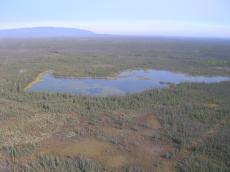
A few nights ago after putting the car in the garage, I stepped outside to the sounds of ray guns overhead. Those ray gun sounds were the calls of a flock of migrating Short-billed Dowitchers flying north from a Maine coast saltmarsh where they had probably spent the day feeding on small invertebrates and marine worms. They were headed to the Boreal to find a peat bog in which to lay their eggs and raise their young.
How can I say that with so much certainty?
That’s because over 95% of the species global population breeds in the Boreal. In fact, the automated nocturnal flight call recording station that I run at my house has recently documented a number of night migrating Boreal breeding shorebirds passing over my house here in Gardiner, Maine about 30 miles from the coast. The list includes Least Sandpiper and Semipalmated Plover (both with more than 50% breeding in Boreal), Greater Yellowlegs, Solitary Sandpiper, and Spotted Sandpiper (all three species have more than 70% of their breeding population in the Boreal).
In the last few days my station has also recorded hundreds of songbird calls including lots of Swainson’s Thrushes and an increasing number of Canada Warblers. I also just received some recorded Swainson’s Thrush call notes from a new recording station at the Teatown Lake Reservation in the Hudson Valley of New York from last week.
As part of our work to understand the issues impacting these birds long-term survival, we have begun mapping different potential risks to Boreal birds within their Boreal breeding grounds. These risk maps help to clarify the management issues that must be considered and that are of highest potential impact at the broadest landscape scale. Take a look at our maps of overlap between Canadian mining claims and the ranges of two of the bird species that have been migrating over us here in Maine this week, Short-billed Dowitcher and Canada Warbler. Both species have shown significant declines over the last 40 years. Historically, Short-billed Dowitchers were much more abundant. I write in my book about one observer describing a May, 1868 flight on the coast of Maine as being 12 miles wide and 100 miles long! Sadly, the subspecies of Short-billed Dowitcher whose breeding range shows the greatest overlap with mining claims and many other industrial activities is the one that is also thought to be the least numerous (the hendersonii subspecies for you fellow shorebird fanatics). Canada Warbler populations have declined by more than 50% since the 1960’s and the species was recently added to Canada’s official list of Threatened bird species. Clearly mining is one of a number of issues that does and will impact populations of these and many other species and consequently we should consider those impacts in landscape planning and management.
Short-billed Dowitcher Map

Canada Warbler Map


May 29th, 2008 at 4:24 pm
On Tuesday night (5/27) there was a major
migration push with hundreds of Swainson’s call notes detected and perhaps
dozens of Gray-cheeks. Last night (5/28) the system picked up dozens of Swainson’s
and a couple of Gray-cheeks and I expact that there will be some continuing
through the first week of June.
Jeff
June 9th, 2008 at 8:29 pm
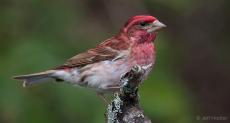
I am studying the breeding birds at a high elevation peatland in western MD. Many of the breeders are boreal, including Canada Warbler, Purple Finch, Northern Waterthrush, Alder Flycatcher, and Swamp Sparrow. This site might be considered a boreal island. How important do you consider such sites, which harbor boreal breeders, located outside of the boreal region?
June 11th, 2008 at 1:50 pm
Hi David,
Yes, this is an interesting question as there are small islands of high elevation boreal habitat extending far south of Canada in the Appalachians and Rockies. And of course there is more extensive lower elevation boreal habitat in the mixed hardwoods ecozones of the eastern U.S. border states. You are probably very familiar with the literature on peripherality but there are competing views about whether and why such peripheral island populations as the ones you are studying are important. There is some evidence that such populations could harbor important genetic variability because of the different climactic conditions and other natural selection regimes they may be experiencing (along with isolation effects)as compared to populations in regions that are located more centrally within the geographic range. On the other hand, small isolated populations are eventually doomed to a high risk of local extirpation without having large source populations from which they can be augmented or repopulated. And, of course, the broad scale ecosystem services and ecosystem functions that may be required for the longest term survival of species can only be maintained in very large intact landscapes. Sadly, populations like the one you are studying are likely to be some of the early casualties of global warming as ranges of plants and animals are forced upslope into eventual oblivion. Maintaining the vast Canadian Boreal ecosystems is one of the best strategies for allowing plants and animals the space and resilience they will need to shift ranges and cope with climate change.
So my bottom line is that locally rare but globally common plant and animal communities are worth protecting from a local or regional perspective and there are some arguments (like the genetic one outlined above) for protection from a global perspective as well. Hopefully protection efforts would never come at the expense of locally common but globally rare plant and animal communities (of which I am sure you have many–for birds I think of Cerulean Warbler as a possible example) or at the expense of globally important ecosystems like the Boreal.
July 17th, 2008 at 8:02 am
hi,
i believe this observation is just new.
do you have any projections of the future population of these bird species?
how worse will the decline in their population be?
are there any negotiations taking place with those mining companies?
thanks