Boreal Bird Blog    

Dr. Jeff Wells is the Senior Scientist for the Boreal Songbird Initiative. During his time at the Cornell Lab of Ornithology and as the Audubon Society's National Conservation Director, Dr. Wells earned a reputation as one of the nation's leading bird experts and conservation biologists. He is now dedicated to understanding and protecting the land where North America's birds are born and raised, the Boreal Forest of Canada and Alaska. Check back regularly to read Dr. Wells' perspectives on the conservation, migration and interesting habits of Boreal birds.

They Don’t Eat the Puffins Anymore

In Maine, people don’t eat puffins any more.  Instead, thousands shell out good money for the chance to see one of the clown-faced birds from the rocking deck of a tour boat.  But there was a time when people took the puffins so systematically that by the early 1900’s many of their nesting colonies on Maine islands were gone.  Who knows the exact date when that last puffin may have returned with the hope of finding a mate and raising its chicks in a dark crevice under the shores jumbled rocks.  That day did eventually come to Eastern Egg Rock, a low 7-acre island five miles off of mid-coast Maine.  Hundreds of years of people shooting and netting seabirds and taking their eggs without thinking of the sustainability of the resource at last left the island devoid of most seabirds. By the 1960’s only a few gulls nested amidst the low vegetation in the center of the island and a handful of the puffins small cousin –the Black Guillemot – nested in the jumbled rocks around the perimeter.

Fortunately for puffins, a host of other seabirds, and all of us – a person with a dream for what many thought was an unattainable conservation benchmark arrived on the scene.  His name was Steve Kress and now 36 years later Steve is still on the scene.   He and his team, at summer’s peak sometimes counting more than 30 staff and volunteers, now watch over three puffin nesting colonies and more than a dozen other seabird nesting islands with thousands of terns, hundreds of puffins, and a variety of other birds .  The puffins were the hardest to bring back because it required flying puffin chicks taken from abundant colonies in Newfoundland the more than 500 miles to Maine, ferrying them out to the islands and then hand-rearing them over the summer a blended fish and vitamin cocktail several times a day!  The most amazing part of the story is that Steve, his family and supporters had to do this for nine years before they coaxed a pair to stay and nest and eventually make the beginnings of a new colony. 

Every summer we like to take the Puffin Watch boat out to Eastern Egg Rock to be reminded of the kinds of conservation successes that are possible if you can dare to think big and not give up.


Puffin Watch Boat Ride
Credit: Jeff Wells


Research Station on Eastern Egg Rock, Muscongus Bay, Maine.
Credit: Jeff Wells.

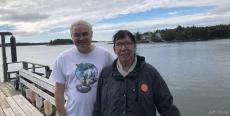
It was almost the last day of August this summer when the family and I made our way down to the wharf at New Harbor, Maine where the Puffin Watch departs.  As we motored out of the harbor, the captain announced that the season was winding down.  More and more nestling puffins were leaving their cozy (and presumably pretty smelly) burrows for their first experience in the open sea where they would spend the rest of their lives.  We did see a single puffin, an adult that flew in and landed near the boat with a fish in its bill for its chick hidden somewhere in the rocks.  By the next day, the chick had left and the puffins were done for the season – a successful season as we learned that there had been a record number of nesting pairs this year!


Atlantic Puffin! The last one of the season.
Credit: Jeff Wells

Below are a few short Youtube videos of my puffin watch trip.

3 Responses to “They Don’t Eat the Puffins Anymore”

  1. Terry Mingle Says:

    AWESOME article, Jeff! Very nicely done. Steve Kress is the best!

  2. Roger Everhart Says:

    They still eat puffins in Iceland.

  3. Leda Beth Gray Says:

    Steven Kress is a conservation hero. His innovative ideas have led to other seabird restoration projects such as restoring Murres to Devil’s Slide Rock off San Mateo County, CA where decoy birds were painted by school kids and left on the islands to attract the birds, and also calls were broadcast. Now they are removing decoys to make room for more breeding birds. The Murres were depleted in the ’70’s and 80’s due to getting caught in fishing nets then got caught in a big oil spill.

Leave a Reply


In an effort to control spam, please answer the question below


  Email Borealbirds.org | 206.956.9040 | E-Update Unsubscribe Copyright © 2005 Boreal Songbird Initiative