Last Stop North
Turkey Vulture
Credit: Kirk Rogers
It’s cold and clear this early February day in Maine. We have about three feet of hard packed snow on the ground and the wide Kennebec River is frozen enough to support a small city of smelt fishing shacks. It seems like winter has us firmly in its strong icy hands. But southerly winds are predicted for later this week and though they won’t be enough to melt much of the snow and ice, I’m almost willing to bet that they will bring in the first migrant Turkey Vultures into our state.
Turkey Vultures rarely even ever occurred in Maine even 40 years ago. I grew up thinking of them as a bird of the land of grits and barbeque. But since then they have pushed northward rapidly to become a common summer breeder and now even an irregular winterer. The Turkey Vultures that make it to Maine on the first south winds of February now probably spent the winter in southern New England.
A new report released today by Audubon shows that it’s not just Turkey Vultures that have shifted their range north but as many as 177 species! Using Christmas Bird Count data, Audubon scientists showed that many birds had shifted north over the last 40 years, some by as many several hundred miles.

Pine Siskins are one of the species showing the greatest northward range shift according to the Audubon report
Credit: Brian E. Small
This is a pattern consistent with hundreds of studies of wildlife and plants that document a clear “fingerprint” of global warming in a multitude of measures of biological activity. Click here to see more about some of the changes in birds of the Boreal as a result of global warming.
Birds and other animals must adapt to global warming or they will disappear. As animals shift their ranges, perhaps on time scales much faster than ever before, their capacity for resilience is reduced when the habitats they can use are fragmented and degraded.
Maintaining very large unfragmented habitats allows animals to move across landscapes so that populations can continue reproducing and adapting to the changes that are unmistakably underway.
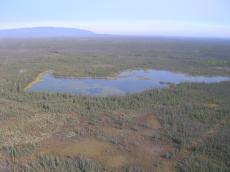
For birds and other animals of the North American continent, the last great habitat refugia on the global warming caused northward ride, is the Boreal. Not only may the Boreal be the Noah’s Ark of ecosystems for North America, it is also one of the greatest shields against further global warming. This is because the Boreal’s cold temperatures have allowed deep layers of peat and other organic material to accumulate for thousands of years. Those layers account for about 27 years worth of all the annual industrial emissions of carbon–a Fort Knox of carbon. But those layers of peaty carbon only serve as our protection if we in turn protect them and the forests above them from industrial disturbances that can make thousands of years worth of stored carbon slop into the atmosphere almost in a moment.
That’s why the announcements by Ontario’s Premier McGuinty and Quebec’s Premier Charest pack such significance for the citizen of North American and the world. Both leaders have pledged to protect at least 50% of the intact Boreal of their provinces, together accounting for an area of nearly 200 million acres. McGuinty and Charest are not just showing leadership for their own provinces or even just for Canada if they succeed in their vision. They will have given a precious gift to all nations and peoples of the world—the gift of a fighting chance for the birds and other wildlife we love and for our children and grandchildren to survive and thrive.
Here is some video of some of the birds that have shown major shifts northward according to the Audubon report.
Pine Siskin—a small finch that is flooding feeders this year in the eastern U.S.:
American Robins—no longer just a sign of spring in many areas:
Even the familiar Black-capped Chickadee has seen a northward shift in its range:


February 11th, 2009 at 6:30 pm
[...] Last Stop North (Feature on Turkey Vulture) [...]
February 18th, 2009 at 7:56 pm
[...] « Last Stop North [...]
February 20th, 2009 at 7:49 pm
[...] of you remember Jeff’s previous post about the recent Audubon report that found 177 bird species have experienced northward movement in [...]
February 20th, 2009 at 9:30 pm
[...] Songbird Initiative Blog – Last week I wrote about the report released by Audubon last week that documented northward range shifts in 177 bird species … In [...]
February 23rd, 2009 at 1:41 am
Heard you on MPBN Friday, including a line about even seeing turkey vultures in Maine, and felt oddly relieved. Two weeks ago, a turkey vulture tried unsuccessfully to land on my office windowsill in S. Portland, and after looking up its typical range, I spent the next two weeks trying to convince myself I must have been mistaken, must have seen something else. The global warming implications are deeply unsettling, but there was some small solace in learning I wasn’t seeing things, especially things that big. Keep up the good work.
February 24th, 2009 at 3:08 pm
Thanks Angus! And interestingly enough the first Turkey Vulture reports came in across the Maine birding listserve the day the MPBN story aired on Feb. 20. Since then several more have been noted and the first “spring” arrival blackbirds have begun appearing–though probably they wish they hadn’t given the snow storm. Must have been quite a sight to see a vulture up that close on your office window as they are massive birds. Hope your work on clean energy to help lower global warming emissions is still moving forward!
March 25th, 2009 at 8:12 pm
[...] seems as if Boreal birds have really stepped into the spotlight recently. It started with the Audubon report that found many birds are wintering further north as a result of warming temperatures, only [...]
May 4th, 2009 at 9:09 pm
[...] shifting ranges and declining numbers among various species in recent decades. You might recall my previous post about the Audubon report that found many species of bird wintering further North as a result of climate change. This [...]