
Boreal Bird Blog    

Dr. Jeff Wells is the Senior Scientist for the Boreal Songbird Initiative. During his time at the Cornell Lab of Ornithology and as the Audubon Society's National Conservation Director, Dr. Wells earned a reputation as one of the nation's leading bird experts and conservation biologists. He is now dedicated to understanding and protecting the land where North America's birds are born and raised, the Boreal Forest of Canada and Alaska. Check back regularly to read Dr. Wells' perspectives on the conservation, migration and interesting habits of Boreal birds.

Carbon-Eating Forests

This week here in Maine we had a major push of Boreal migrants through the state. On Wednesday night a friend and I listened as nocturnal calls of southbound migrants rang out from above the house at a rate of six per minute. That’s about 360 bird calls per hour or about 2800 over the course of a night and that’s just from one small location. Imagine how many birds must have migrating that night if the migration wave extended from Chicago to Maine? We heard many Swainson’s Thrushes and lots of warbler calls that certainly would include species like Blackpoll, Bay-breasted, Magnolia Warblers and many others. At the same time as these birds were migrating south, two scientific papers came out that have important implications for the future of Boreal birds.

A paper that appeared in the journal Nature, clearly demonstrated that protecting the remaining intact, mature Boreal forests is essential for combating global warming. Why? Because the author’s careful analysis of previously published studies showed that forest ecosystems continue to sequester lots of carbon even as they become old. This counters a widely held but never well-supported belief among some quarters that it might be better to cut down old-growth forests in order to replace them with fast growing young forests because the young forests suck up lots of carbon. Not true, as the authors of this study document.

The Canadian Boreal contains something like 25% of the remaining intact, untouched forest on the globe. We now know that protecting large swaths of it is vitally important for continuing to lower the levels of carbon in the atmosphere that are causing global warming.

That could be good news for birds.

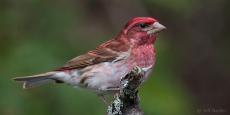
Another paper that was recently published has documented the severe decline of a Boreal breeding species and popular backyard feeder bird, the Evening Grosbeak. The paper points out that the highest densities of breeding Evening Grosbeaks occur in the oldest forests and current levels of forestry in the Boreal are not only reducing the age of forests but are also making them all of the same age (that is, there is less diversity of different age classes). The dramatic drop of Evening Grosbeak numbers may be a result, at least in part, of the legacy of industrial forestry in the southern Boreal.

For the Evening Grosbeak and many other old-growth forest loving Boreal birds, letting policy makers understand that protecting intact Boreal forest is part of the solution to fighting global warming as the Nature paper did, could be the factor that allows them to have the habitat that they need to survive and thrive.

Now that Ontario has led the way with its recent announcement of its plans to protect 55 million acres of these carbon-eating Boreal forests, maybe other provinces will see that they can make a global commitment to helping a global problem by protecting 50% of their Boreal forests.

3 Responses to “Carbon-Eating Forests”

  1. Audubon Birdscapes Says:

    IATB #84 A Beginner’s Guide to Bird Blogs…

    There weren't many bird blogs around five years ago. Today, thousands of blogs at least occasionally…

  2. Darlene Salter Says:

    In response to the “Carbon-Eating Forests, I really agree that mature boreal forests need to be retained for habitat and for moderating our global climate. I moved to Dryden, Ontario in 1974 after graduating with a biology degree. I was alarmed about the huge clear-cuts in the 1970’s in the southern boreal forests. The northern boreal forest was untouched then. I am sorry to say that the environmental situation is worse in spite of the loss of half the forestry employment since 2003. Our southern boreal forest continues to be harvested in an unsustainable manner and tree harvesting has entered the northern boreal forest . So called forest fire emulation means larger cuts than moose block cuts and harvesting of younger stands of forest. Forest fire emulation and the use of chippers instead of transporting round logs has resulted in less mature forest and old growth forest across the landscape. Jack Pine stands will never provide nesting sites for Evening Grosbeaks unless they are in marten cores, shoreline reserves or parks. Poplar trees will never have large enough diameters for Pileated Woodpecker nesting and roosting cavities unless they are in marten cores, shoreline reserves or parks. Our trees are being chipped into pulp and biofuels. They don’t need to grow to maturity. If trees are harvested at 50 to 6o years of age then that forest has 30 to 40 years of lost habitat for breeding birds and other wildlife. Moose need mature and old growth forest for shelter and food. Moose overheat in clearcuts and are easier to hunt.

    The southern boreal forest has many beautiful lakes and historical canoe routes. The shoreline reserves give an elusion of wilderness in the clearcut areas but if one looks closely at the beautiful treed shoreline while paddling, too often the empty spaces of a huge clearcut can be seen. The logging roads are everywhere and our government is using tax money to fund primary roads. Instead of constructing secondary and tertiary roads, the companies are trying to construct primary roads wherever the MNR lets them. Primary roads are very invasive and fragment the forest even more.

    Domtar in Dryden received FSC certification this summer. I no longer have faith in FSC certification as a result because the Wabigoon 2008-2018 was not a sustainable plan. The approved plan allowed an increased harvest of more than 1000 hectares per year and the harvesting of younger forests. Currently, the plan is being reviewed by the Ministry of the Environment because of requests for individual environmental assessments.

    A balance must be reached between the importance of mature forests as habitat and contributions to the local and global environment and trees for fiber. I have been surveying boreal birds since 1974 and I would like to see the southern boreal forest receive more protection.

    Darlene Salter, naturalist

  3. charlotte kinesiologist Says:

    We have to stop killing live things and replacing them with dead things.
    charlotte chiropractor

Leave a Reply


In an effort to control spam, please answer the question below


  Email Borealbirds.org | 206.956.9040 | E-Update Unsubscribe Copyright © 2005 Boreal Songbird Initiative