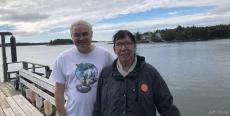
Dr. Jeff Wells is the Senior Scientist for the Boreal Songbird Initiative. During his time at the Cornell Lab of Ornithology and as the Audubon Society's National Conservation Director, Dr. Wells earned a reputation as one of the nation's leading bird experts and conservation biologists. He is now dedicated to understanding and protecting the land where North America's birds are born and raised, the Boreal Forest of Canada and Alaska. Check back regularly to read Dr. Wells' perspectives on the conservation, migration and interesting habits of Boreal birds.
Posted by dchilds13 at July 18th, 2008 Permalink | Comments: no responses Trackback URL for this post: http://www.borealbirds.org/blog/wp-trackback.php?p=103
A record number of viewers read Jeff’s blog earlier this week, which thanked Ontario’s Premier Dalton McGuinty for his bold and decisive action to protect the Boreal Forest. It was a truly remarkable announcement, and hundreds of millions of birds will be protected from expanding mining and foresting industries.
Now it’s our turn to send thanks to Premier McGuinty for his commitment to preserve 50% of Ontario’s Boreal Forest. Please click the link below and send your message to the Premier thanking him for his courageous leadership:
Posted by Jeff Wells at July 15th, 2008 Permalink | Comments: 10 responses Trackback URL for this post: http://www.borealbirds.org/blog/wp-trackback.php?p=102
Dear Premier McGuinty,
I don’t know if you have ever heard the soft flutely song of a Swainson’s Thrush but try to imagine three million of them singing at once. That’s the sound emanating into the sky on a June morning from the number of Swainson’s Thrushes that would be found in the 55 million acres of northern Ontario’s Boreal that you have just announced will now be protected. Even better yet imagine 4.5 million renditions of the “Oh-sweet-Canada-Canada-Canada” song of the White-throated Sparrow echoing across the Boreal.
That’s a sound that should be heard around the world. I have no doubt that if they knew, those Swainson’s Thrushes and White-throated Sparrows would be joined by the five million Dark-eyed Juncos, four million Magnolia Warblers, three million Palm Warblers, two million Tennessee Warblers—the total number found in the 55 million acres would likely be in the hundreds of millions—in a chorus of songs of thanks so deafening that it would make us all stop whatever we were doing.
I’d like to imagine what it would sound like to hear the 70 million bird enthusiasts in the U.S. celebrating the news that chances just went up that their grandkids would be able to experience the same joy and excitement and connection to birds that they experience. In the next few weeks, fall migration will start sending those hundreds of millions of birds pouring south into the U.S. and beyond where we will feed them, watch them, photograph them.
Well not all of them will leave. The two million Gray Jays and one million Boreal Chickadees who live in those 55 million acres of soon-to-be protected Ontario Boreal habitat will stay put for the winter.
But one-and-a-half million Blackpoll Warblers from those 55 million acres will soon start their long journey to the Amazon Basin—maybe you’ll get a thanks from Peru or Ecuador or Brazil too. Or from the Caribbean for the half a million Cape May Warblers you will be increasing the odds that they will receive from Ontario’s protected areas each winter.
Protecting 55 million acres is an amazing and boldly important move at a time when we need good news that recognizes the balance of human values that all of us care about.
Thank you for one of the world’s most significant conservation actions in history. Thank you that my son will still have the opportunity to step outside on the porch with his son or daughter beside him on some crisp October night here in Maine and listen to a sky filled with the sounds of migrating birds. Birds that raised their own families in a safe and secure habitat far to our north in a special place called Ontario.
Posted by Jeff Wells at July 14th, 2008 Permalink | Comments: one response Trackback URL for this post: http://www.borealbirds.org/blog/wp-trackback.php?p=101
Credit: Jeff Wells
I wasn’t sure that Eddie would be joining me today (Monday, June 23) for early morning bird surveys and sound recording as he didn’t stir until I was out of the tent. The early mornings, late nights, and, of course, the paddling, had begun to make our eyes and aching backs beg our brains for just a few more minutes of sleep.
Today, our last day on the water, we had a specific goal of recording sound samples from around the shores of Triangle Lake. The idea, and really the idea of our whole trip, was to preserve in audio recordings a sample of what a small part of the still road-inaccessible Boreal sounded like during the peak of summer bird song. I had been recording the natural sounds at our campsites each morning (and sometimes evenings) all along our route but today I wanted to get a more concentrated sample from around Triangle Lake before we met our float plane outside of Fort Hope.
Triangle Lake
Credit: Jeff Wells
It was perfect canoeing and recording – weather with hardly a puff of wind so that the clouds and sky mirrored clean and clear on the water. We decided to leave our packed drybags on shore to pick up on the way out just to make it easier and faster paddling. Our first stop was almost directly across the lake from our campsite and it yielded what was surprisingly our first Gray Jay. A uniquely Boreal species, the Gray Jay is known by people who live and travel in the north as a familiar sight around campgrounds and places where it can mooch food. In this area, apparently the campsites were so infrequently used that the jays had not established routine visits to such places. Finding them up here meant stumbling on them by chance.
We spied the second stop from across a small bay. It was a large rock outcropping about 50 feet up above the lake shore, surrounded by spruces rising up from a thick carpet of lichen and moss. The acoustics were perfect here with the “teacher-teacher-teacher” of an Ovenbird ringing in from across the lake, the occasional cry of a Common Tern echoing from somewhere out over the water, a Northern Waterthrush singing from the shore below, and nearby in the spruces the soft flutey notes of a Swainson’s Thrush.
A few more stops later (Eddie finally got a look at a Tennessee Warbler at one and a Ruffed Grouse and Bald Eagle called at another, though not while I was recording) and we headed back to pick up the rest of our gear and paddle toward Fort Hope. We passed a group of Bonaparte’s Gulls and Common Terns on a log and some more feeding in a shallow bar area covered in small willows and grasses, now partially submerged because of the high water. Small flocks of Mallards rose up from the grasses and wheeled around us and settled down again after we had passed by. Soon the passage narrowed and we moved from the lake into the river outlet of Eabamet Lake with a surprisingly strong current flowing against us. In the middle of a hard upstream paddle I heard a new bird for the trip, the buzzy “zee-zee-zee-zoo-zee” of a Black-throated Green Warbler. It was early afternoon when we made it through to Eabamet Lake where Fort Hope was located a few miles across. The trip’s first Hermit Thrush sang its lonesome song from a headland as we paddled by and then we heard the buzz of the big orange floatplane. We hadn’t quite made it to Fort Hope but we were thankful when we saw the plane tip around and land on the water just ahead. Our pilot was an amazing guy who had learned to fly as a teen but had left flying to spend a career as a lineman for an electric company. There, while still in training, he had blown away part of his hand in an electrical accident but never quit. He had come back to flying again in later years and now flew year round across northern Ontario. After stowing our gear and loading our canoes on the pontoons, he picked up for the short hop across the lake to Fort Hope. Here Eddie hoped to interview someone from the community about their views of the changes that were likely to come if roads and logging eventually reach the Albany River and their community.
Fort Hope
Credit: Jeff Wells
It took three passes by the dock to get the ten or so kids who were swimming there to move back so we could get the plane in. The kids were having a great time, throwing in an empty water bottle and screaming and yelling as they leaped in to see who could get it first. Eddie went ashore to the First Nation offices for his interview while Per, Tim, and I walked up the dusty dirt road toward the general store and post office. I was surprised to see a European Starling here in town—a species that since its introduction to North American in New York City in the late 1800’s has become one of the most common birds across the U.S. and southern Canada. Was this a harbinger of what was to come as industrial development creeps closer?
An hour later we were in the air again, watching the town’s rows of houses and airstrip (there is regular air service here) fade into the distance, eventually looking like a small light spot among a sea of forest. We flew south over wilderness into the northern reaches of the Ogoki forest with lakes and streams and bogs and woods stretching away as far as we could see. The pilot spotted a pair of moose feeding on the edge of a dark stream and we circled around a few times for Per to try for some photos.
It was only about 25 miles from the unroaded, unfragmented forest through which the Albany River flows that we came to the edge of the final frontier. There below us were the access roads and massive clearcuts with towering stacks of spruce poles that had been trees. These trees could well be catalogs and junk mail by Christmas. It was a hard contrast from what we had just experienced.
Credit: Jeff Wells
Later we looked at a map and discussed how roads are planned to reach parts of the area where we had just paddled, including Fort Hope, within the next 10-30 years. We had documented the birds and sounds of one of the world’s last wild places. I wondered if there would be a day when stories, memories, and a few archived sound recordings would be all that was left.
Listen to some of my recordings from the morning at Camp 3: Clip 1 (listen) Clip 2 (listen) Clip 3 (listen)
Also, take a look at the recent land conservation announcement by the Government of Ontario!
Posted by Jeff Wells at July 7th, 2008 Permalink | Comments: no responses Trackback URL for this post: http://www.borealbirds.org/blog/wp-trackback.php?p=100
Credit: Jeff Wells
The birds were a little lazier here at Camp 2 on Kawitos Lake than at Camp 1 on Petawanga Lake. The first bird I heard on Sunday morning (June 22) was a robin calling—it sounded like it had landed on the tent—at exactly 4:24. But it didn’t take long before the sound became almost deafening. Tennessee Warblers blasted their mechanical “chit-chit-chit-chu-chu-chu-titititititi;” Ruby-crowned Kinglets belted out their rollicking songs; Alder Flycatchers did their rolling “ree-bee-o”. All of these species and at least thirty more were filling the air at once with a density of sound. Behind it all there was the occasional slap of a beaver tail. Eddie and I counted birds and recorded sounds until almost 10 that morning. The last of them we found a perch on top of an old beaver lodge looking out over the outlet of a small stream behind our campsite. As I pointed the microphone north across the water I imagined listening through the wilderness the 300-plus miles to Hudson Bay across forests, rivers, lakes, and peatlands where no road existed.
The paddle up to the second and final portage of our trip was through beautiful dark flatwater where the bird sounds could be heard distinctly as we glided through. Eddie and I chatted a lot through here with lots of drafting so we could both jot down notes while Per could be heard occasionally giving directions to Tim on where he wanted the canoe for that perfect photo. We passed a large nest that we assumed was a Bald Eagle’s since we had seen one nearby but an Osprey was also in the area and no one could be seen on the nest itself. Just as we reached the portage I heard the distinct “quick-three-beers” whistle of the one and only Olive-sided Flycatcher of the trip—a species that sadly was just added to Canada’s list of threatened species.
This portage trail was shorter, wider, and more well taken care of than the last one and we had everything carried over in under 30 minutes. The flies were a nuisance here so we paddled just offshore from the portage and the outlet of the rapids and ate our lunch while drifting. A group of nine Bonaparte’s Gulls and two Common Terns swooped low over the water near us as we ate and soon after we started paddling I heard the distinctive buzzy “zeeeee-up” song of a Northern Parula which, despite its name, is apparently decidedly rare this far north.
We made it into Triangle Lake around 4:30 in the afternoon. Unlike most of the route so far, the lake was blessed with an abundance of ruggedly photogenic and relatively bug-free ledges draped in lichens and mosses. We stopped at one on the south side of the lake and were about to unload when Per, his photographer’s eye always on the prowl, spotted what looked like his dream spot across the lake. He and Tim set out to check it out while Eddie and I waited. Fifteen minutes later a paddle wave beckoned us across to what had to be the most incredible camp yet. Perfect flat spots for out tents, rock benches and tables for cooking, easy access for fishing, an amazing view and best of all—a drumming Ruffed Grouse that kept us company until nightfall.
Relaxing sounds from the morning at Camp 2 (listen)
Posted by Jeff Wells at July 3rd, 2008 Permalink | Comments: no responses Trackback URL for this post: http://www.borealbirds.org/blog/wp-trackback.php?p=99
And all this within two-hundred yards of our campsite at the eastern end of Petawanga Lake.
Listen to some of the recordings: Common Loon with Magnolia Warbler and Swainson’s Thrush (listen) Red-eyed Vireo and Bay-breasted Warbler (listen) Magnolia Warbler with Swainson’s Thrush and Yellow Warbler in background (listen)
We had been able to hear the rapids from our campsite in the still early morning air and within forty minutes we had come to a fork in the river. A right would take us over the rapids while a left would bring us to a portage marked by the guide. I was relieved as I heard Eddie’s shout to Per and Tim, “Stay to the left!”
We found the portage trail very easily—the overturned boat on shore helped—but Per was intrigued with another idea. The map showed what looked like a series of beaver flowages that made it all the way around the portage, connecting back to the river below the falls. With this year’s very high water from the rains that had fallen regularly over the past few weeks, he thought it might be possible to wade and pull the canoe through. The thought of not having to haul all that gear across a half-mile portage made the idea sound pretty appealing.
So we gave Tim and Per a radio and watched them slide their green canoe over the first beaver dam and disappear into the willows. Eddie and I unpacked our canoe and Eddie shouldered the first load—a large drysack on his back and the food barrel on his chest—while I did a couple of quick point counts (Nashville Warbler and Yellow-bellied Sapsucker were new finds) before following him up the trail.
My untempered back began feeling the strain within a few hundred yards and my attention to bird songs began to fade as the pounding in my head increased. The trail was narrow in places with thick trunks of downed trees across it in spots. I struggled more than once to keep from tipping over as I lunged to hop the heavy pack onto a log so I could swing a leg over.
I was perhaps two-thirds of the way through this nightmare—just beyond a bend in the trail where recognition of a Blackburnian Warbler’s song had penetrated through my muddle of pain and sweat—when I saw Eddie coming back toward me. “Yes, the end,” I thought, until I noticed that Eddie was still carrying the same load he had left with. Worse yet, he didn’t even seem to be out of breath.
“This trail doesn’t bypass all the rapids,” he said. “We could probably do it fine if we have to…” His voice trailed off in way that suggested a possibility for misadventure. The thought of having to haul my load all the way to where we started almost made me think it might be a good idea.
Almost, but not quite. I huffed and hauled and stumbled my way back to the canoe. That’s when Eddie pointed out that I didn’t have the straps on the dry bag properly adjusted.
“If you pull these up and cinch this around your waist it would be a lot easier,” he said.
“Next time,” I murmured as I massaged the furrows in my shoulders.
We called Tim and Per repeatedly on the radio. Except for a few itinerant beeps, we got no response. Later we found that Tim had fallen in the water with the radio in his pocket. We waited and waited some more to see if they would come back or show up down the portage trail. Finally we decided we might as well follow. The trail of green paint marks on the rocks let us know they were still ahead as we pulled and heaved and stumbled through willows and rocks and occasional holes that hit waist deep.
Three to four beaver dams, one drenching, and a few skinned ankles later we were still following the trail of green paint when we came to a boulder field. Per popped up from the downstream willows. “This is the last of it,” he said. “And this is the perfect setting for me to get some photographs of Eddie carrying the canoe since there’s no other way through anyway.”
Portage
Credit: Jeff Wells
A Broad-winged Hawk—a species that reaches its northern range limit on this area—called as we at our lunch at the end of the portage.
Several hours later we pulled ashore amid light rain showers above a small rapids that the guide had said we didn’t really need to portage around. Eddie bushwacked through the woods to take a peek and see what he thought. I counted birds and wiped hordes of mosquitoes and black flies from my hands. “No problem,” Eddie said. Not to mention there was no real portage trail anyway.
It wasn’t much of a rapid but it was pretty fast and fun and in seconds we were on the other side and into Kawitos Lake. I knew that Eddie had figured me out when, as we were going through the rapids, he suddenly shouted to me from the back of the canoe, “We’re going to paddle towards those mergansers on the right.”
We made camp that night on a small beach with a Northern Waterthrush singing just yards behind the tents, a Common Loon feeding just offshore, and the biting insect trifecta—mosquitoes, black flies, and tiny no-see-ums—hovering under our cook tarp. A small campfire on the beach and some deet took care of that problem and we ate a meal of pike and walleye as the evening sky turned pink.
Click here listen to the evening chorus of spring peepers at campsite two
Posted by Jeff Wells at July 2nd, 2008 Permalink | Comments: no responses Trackback URL for this post: http://www.borealbirds.org/blog/wp-trackback.php?p=98
Credit: Jeff Wells
I wondered what kind of trouble I might be in when Eddie, a well-known writer for Audubon, Field and Stream, and many other magazines, casually mentioned minutes before take-off from Miminiska Lodge that he was best-known for canoeing wilderness rivers without guides and then writing about the adventure. That feeling was compounded when I discovered that Per, the photographer, was a veteran of various Arctic and Antarctic expeditions with National Geographic. Heck, even Tim, the photographer’s assistant was an endurance athlete who regularly competes in 24-hour ultra-marathons and 500 mile bike races!
As they compared the various kinds of river shoes and portaging boots they were wearing, I looked down at my old sneakers and gulped.
We took off from the wilderness lodge at Miminiska with all our gear stowed and two canoes strapped to the pontoons with the hope that we might be able to find one of the local guides from the First Nation community of Fort Hope who was out with a fishing client on the lake. No, we weren’t going to ask him to come along but Eddie was interested in at least asking him to make some pencil marks on the map where the rapids were, portage trails, and potential campsites. And so a few minutes after take-off we were landing on another part of Miminiska Lake near a couple of small boats. The guide came over and with what turned out to be a level of accuracy that a cartographer would be proud of, he marked everything we needed to know on Eddie’s maps.
Miminiska Lake map
Credit: Jeff Wells
And then we were off again and within 15 minutes we had been deposited on Petawanga Lake. It was about 3:30 in the afternoon when the twin otter float plane disappeared over the tree tops and we were finally enveloped in that calming quiet that you can only find in places like the Boreal. It took us about an hour before we figured out which part of Petawanga Lake we were on and then came the showers and rumbles of thunder. As we paddled, the harsh squawks of Bonaparte’s Gulls would come floating in over the water from small groups feeding here and there with a few Ring-billed and Herring Gulls mixed in. From the shores there were the rising flutey songs of Swainson’s Thrushes and the clear whistled “Oh-Sweet-Canada-Canada-Canada” songs of White-throated Sparrows. A Bald Eagle flew over and several Common Loons fished nearby.
Bonaparte’s Gulls
Credit: Jeff Wells
We made camp on a flat section of an island where a beaver had gone crazy, gnawing down an entire stand of aspen. While looking for a good campsite we flushed two hen Mallards from nests, a Merlin called from the ridge behind us, and a Northern Waterthrush sang loudly.
That night I laid for what seemed like hours in a stifling hot tent listening to the chorus of spring peepers and the occasional echoing cries of Common Loons and thinking about the start of our adventure. For all their hardy back-country gusto, my traveling companions had made sure this particular trip was more perfect for documenting the bird life of this one stretch of a Boreal river than for risking life and limb on whitewater rapids hundreds of miles from the nearest emergency help. Not to mention that Per was carrying expensive camera equipment and I a sensitive microphone and digital recorder—not equipment you want to risk seeing floating down river while you are clinging to an overturned canoe. Nothing to worry about…..at least until we reached our first rapids and portage the next day.
Listen to a Winter Wren recorded at Camp 1 on Petawanga Lake.
Posted by Jeff Wells at June 23rd, 2008 Permalink | Comments: no responses Trackback URL for this post: http://www.borealbirds.org/blog/wp-trackback.php?p=97
Friday June 20th:
Arrived at Miminiska Lodge on Miminiska Lake (part of the west-to-east flowing Albany River) 51 degrees north in Ontario… after an incredible 90-minute 240-mile flight north from Thunder Bay on Wilderness North’s big DeHavilland Otter floatplane…canoes strapped to the struts and all four of us, our gear, and a crew from Wilderness North inside with room to spare.
By 4pm we were on our “paddle” in our two canoes on the Albany River… with three days to reach our destination of Fort Hope – the Canadian First Nation Eabametoong Reserve.
All around us is a sea of forest – mile after mile of tall pointed black spruce intermixed with the early summer minty green aspens and birch stacked like lollipops above the majestic 50-foot spruce and pine.
I’ll be making sound recordings of the birds and keeping a diary, while Per – with his assistant Tim – photographs this wilderness splendor.
Eddie takes notes for an article he’ll be writing. And we all paddle on into expected scattered rain, even thundershowers for day one of our three-day adventure.
Posted by Jeff Wells at June 19th, 2008 Permalink | Comments: no responses Trackback URL for this post: http://www.borealbirds.org/blog/wp-trackback.php?p=96
I will be headed north on a 4 day canoe trip on the Albany River of central Ontario for some bird sound recording, and unfortunately will not be able to blog until my return. I will be sure to report on my trip next week!
Posted by Jeff Wells at June 11th, 2008 Permalink | Comments: no responses Trackback URL for this post: http://www.borealbirds.org/blog/wp-trackback.php?p=95
Blackpoll Warbler
Credit: Jeff Nadler
I just came across a recently-published paper (see citation below for Perlut et al. 2008) that documents some of the surprising ways in which human-caused changes in habitat can impact birds. In Bridget Stutchbury’s book, “Silence of the Songbirds” (on Amazon.com) that I mentioned last week, she explains that birds need neighborhoods not just habitat. By that she means that they need to breed in places where there are lots of others of their species breeding close by.
Why?
It turns out that in most bird species, both males and females try to increase their breeding success and offspring quality by mating with the highest quality birds around them—often not just their mate. When forests are fragmented, it becomes harder and more dangerous to fly from fragment to fragment to assess and mate with other birds thereby disrupting mating systems.
The authors of the recent paper were able to show that in the case of their study populations of Savannah Sparrow, hay harvesting changed the potential evolutionary pressures by changing the social system (more polygynous pairings in undisturbed habitats as compared to more monogamous pairings in cut-over hayfields).
To quote from their paper:
“These changes doubled the strength of sexual selection, and as a consequence, potentially altered evolutionary processes of the population.”
The traditional view is that habitat loss and fragmentation can decrease the number of birds that survive and reproduce because of impacts like decreased resources and increased predators. Now we find that the social systems can be disrupted causing not just decreases in numbers but potentially some profound changes in evolutionary pressures and genetic variation in the species.
If you want to get all the details about why and how you may want to read:
Perlut, N.G., C.R. Freeman-Gallant, A.M. Strong, T.M. Donovan, C.W. Kilpatrick, and N.J. Zalik. 2008. Agricultural management affects evolutionary processes in
a migratory songbird. Molecular Ecology 17:1248–1255.
AND
Stutchbury, B. 2007. Silence of the Songbirds. Walker Publishing Company, NY. (chapter 9-Living On the Edge).
____________________
On another note, I spoke about my new book “Birder’s Conservation Handbook: 100 North American Birds at Risk” on WICN Public Radio on Sunday, June 8 - click here to listen to my interview.
Posted by Jeff Wells at June 4th, 2008 Permalink | Comments: one response Trackback URL for this post: http://www.borealbirds.org/blog/wp-trackback.php?p=94
Looking for some great summer reads about birds and bird conservation? Here are a few that I have enjoyed recently.
A book full of fascinating stories that weave together Stutchbury’s years of field experience and research with easy-to-understand explanations of the state of our understanding about bird ecology and behavior and how they interact with the issues impacting bird populations. I was taken-aback by the stats on pesticide use here and in Latin America and intrigued by the discussion of how fragmentation of habitat can change the behavioral and social fabric of bird species.
Of a Feather: A Brief History of American Birding by Scott Weidensaul Order from Amazon.com
Scott has done it again in this wonderful book. He traces a journey that starts with an acknowledgement of Native Americans as the first birders/ornithologists, ends with the bizarre birders who participate in New Jersey Audubon’s World Series of Birding, and has the kind of stops in-between that make you want more.
No Way Home: The Decline of the World’s Great Animal Migrations by David Wilcove Order from Amazon.com
Not only does this book open up your thinking about migrations to include insects, fish, and mammals along with birds, but it brings into sharp focus the losses of migratory species and behavior that have already occurred. Wilcove really made me think even more about why protecting large intact ecosystems like the Boreal is important.
Songbird Journeys: Four Seasons in the Lives of Migratory Birds by Miyoko Chu Order from Amazon.com
Miyoko is able to capture the jaw-dropping spectacle of bird migration, summarize the intricacies of the newest findings about what limits bird populations during breeding and winter, and make you want to get out and look and listen for birds—all in under 300 pages! I love the discussions about studying nocturnal migration and it is great to see the sections on the importance of the Boreal for bird conservation.
Hope is the Thing With Feathers: A Personal Chronicle of Vanished Birds by Christopher Cokinos Order from Amazon.com
Although this book was published back in 2000, I had never gotten around to reading it until recently but I am really glad I did. Cokinos does a masterful job of weaving together history, biology, and the personal stories of the real people who were involved in studying and trying to save the last of North America’s extinct birds. It may sound ominous but Cokinos finds a way of bringing it back to hope for the future.