
Guide to Boreal Birds
 Duck-like Birds
 This is an in-depth boreal species profile.
What is this?
This species is one of more than 30 birds selected for in-depth profiles. Find out why and see all selected boreal birds »
Overview
Closely related to the aptly named Common Goldeneye (Bucephala clangula), the Barrow's Goldeneye is less common in the boreal forest; yet, it too relies heavily on habitat found in the boreal forest. Body size, shape of the mandible and head, and breeding plumage are the main distinguishing characteristics between the two species. Similar to the Common Goldeneye, the rapid wing-beat of their wings produces a whistle when in flight.
Barrow's Goldeneye favors alpine lakes, often breeding at elevations of 10,000 feet (3,000 meters) or more. It is usually found in smaller flocks than the Common Goldeneye. It feeds almost entirely on mollusks obtained by diving, but also takes an occasional snail, sea urchin, or marine worm. While there are well over a million Common Goldeneyes in North America, the population of Barrow's Goldeneyes is less than 200,000. Its patchy distribution suggests that it is an ancient species that was once more widespread and is now in decline. In the East, it is greatly outnumbered by the Common Goldeneye but may occur in flocks of hundreds in the Canadian Maritimes.
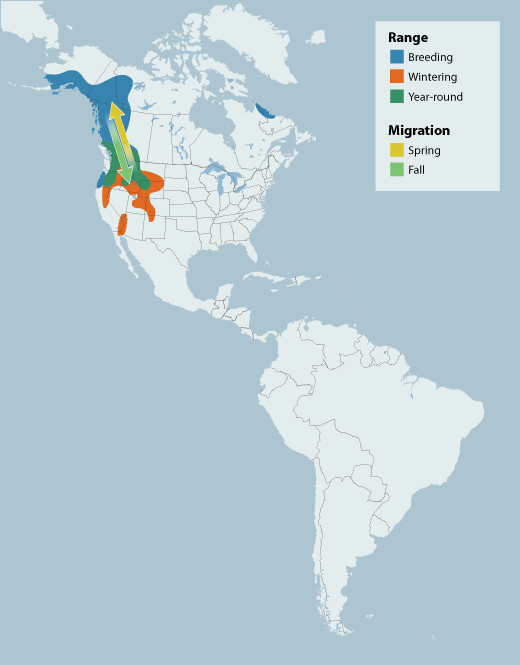
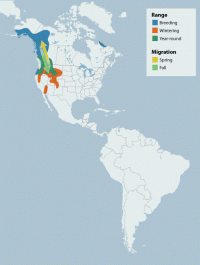
The Barrow's Goldeneye's summer and breeding ranges are separated into 2 distinct populations (western and eastern). The western population's range includes Alaska, the Yukon, British Columbia and Alberta. The smaller eastern population's breeding range is limited to Quebec and small portions of the Maritimes and Labrador. The winter range for both populations is largely the same area mentioned above, although the southern extent broadens into the Pacific Northwest and the northeastern United States for the western and eastern populations, respectively.
Description
16 1/2 -20" (42-51 cm). Male has white body, black back, and black-appearing (actually glossed with purple) head. Similar to male Common Goldeneye, but has more black on sides, stubbier bill, and crescent-shaped, rather than round, white spot in front of eye. Female gray with brown head, white collar, and (usually) orange-yellow bill. Both sexes differ from Common Goldeneye in having steeper forehead and smaller white wing patches.
Voice
Soft grunts and croaks during courtship; otherwise usually silent.
Nesting
5-15 pale green eggs on a bed of down in a hollow tree or, in treeless areas, in a crevice among rocks.
Habitat
The Barrow's Goldeneye is considered an arboreal species because it nests in cavities found in mature trees. In the summer, they prefer alkaline wetlands with open water, little emergent vegetation, high invertebrate populations, and an absence of fish. During migration they will use large inland lakes and rivers. They most commonly winter in sheltered coastal areas, but occasionally do winter on ice-free lakes and rivers in the interior.
Range/Migration
The species experiences three distinct migration periods: a spring movement from wintering to breeding grounds, a summer movement of males to moulting areas, and a fall migration from the staging grounds to wintering areas.
Paired Barrow's Goldeneye are known to travel to their spring breeding grounds by themselves, while non-breeders and unpaired birds normally fly in small groups. Some non-breeding birds will fly directly to moulting areas. Their fall migration typically occurs later than other duck species. Most Barrow's Goldeneye do not leave their staging areas until freeze-up has occurred. Males normally arrive to their wintering grounds earlier than females and young-of-the-year birds. Western and Eastern populations remain isolated from each other year-round.
Breeding
The Barrow's Goldeneye out competes the other two members of the Bucephala species (Bufflehead and Common Goldeneye) for optimum breeding grounds. Its breeding range is limited to areas that provide suitable nesting sites, primarily near productive, alkaline lakes within parkland areas. This duck will nest in existing cavities of dead or dying trees.
Courtship displays that lead to pair bonds are initiated during the winter months (November through to April). These elaborate courtship displays are often made in small groups of 5-20 birds. Once a pair bond is established, they will aggressively defend their mate and nesting area. They will stay paired until the female has completed egg-laying. The male will leave the breeding area and group with other males and non-breeding ducks to moult. Consequently, the female becomes more aggressive towards other females and broods during brood rearing to defend her brood-rearing area.
The female will lay 6-12 eggs (average 9 eggs). Larger clutch sizes are usually an indication of nest parasitism. Incubation ranges from 26-36 days (average 30 days), and their nest success is relatively high. Re-nesting is rare, and may only occur when a nest has been destroyed during laying or the very early stages of incubation. Brood survival is difficult to measure in this species, due to a high tendency for broods to amalgamate, but one study showed 10% of ducklings died before reaching 7 days old. Ducklings begin to fly in approximately 8 weeks. Sexual maturity normally occurs in their second or third year.
Diet/Feeding Behavior
This species normally feeds by diving and occasional dabbling, along shallow shorelines. Typical dives are about 1 – 3 meters below the surface. Their diet is dependent on their location in fresh or salt water, and is made up of aquatic invertebrates, crustaceans, mollusks, and smaller amounts of seeds, green plant material, fish, and fish eggs.
References
Bellrose, F.C. 1980. Ducks, geese, and swans of North America. Rev. ed. Stackpole Books, Harrisburg, PA.
Campell, R.W., N.K. Dawe, I. McTaggart-Cowan, J.M. Cooper, G.W. Kaiser, M.C.E. McNall. 1990. The Birds of British Columbia, Volume 1, Nonpasserines. UBC Press, Vancouver, BC.
Eadie, J.M., M.L. Mallory, and H.G. Lumsden. 2000. Barrow's Goldeneye (Bucephala islandica). In The Birds of North America, No. 548 (A. Poole and F. Gill, Eds.). Philadelphia: The Academy of Natural Sciences; Washington, D.C.: The American Ornithologists' Union.
Federation of Alberta Naturalists, 1992. The Atlas of Breeding Birds in Alberta. Edited by Glen P. Semenchuk. Published by the Federation of Alberta Naturalists, Edmonton, AB.
Credits
Birding content provided by National Wildlife Federation/eNature, with support from Ducks Unlimited/The Pew Charitable Trusts.