Guide to Boreal Birds

 Duck-like Birds
 This is an in-depth boreal species profile.
What is this?
This species is one of more than 30 birds selected for in-depth profiles. Find out why and see all selected boreal birds »
Overview
These beautiful ducks, smaller relatives of the goldeneyes, fly fast and usually close to the water but make no whistling sound in flight. They tend to travel in smaller flocks than goldeneyes and often feed closer to shore. While a flock is diving for food there is almost always at least one bird on the surface watching for danger.
Considering the diminutive size and active nature of the Bufflehead, it seems out of character that this duck's nickname should be "butterball" a name coined by hunters to how fat the Bufflehead is during fall migration.
Description
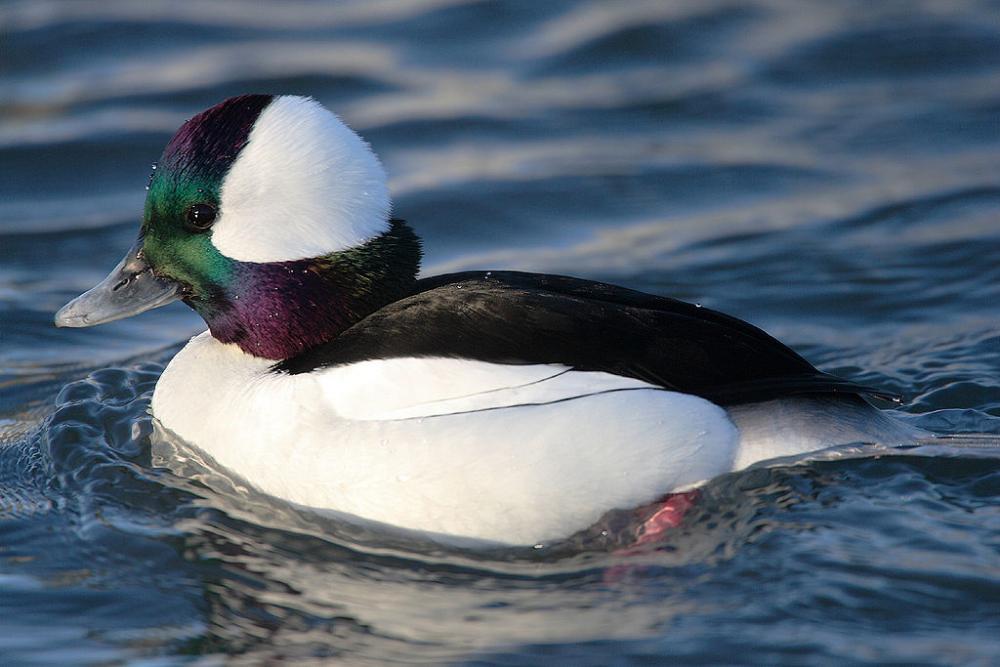
13-15" (33-38 cm). A small, chubby duck. Male largely white, with black back, black head with greenish and purplish gloss, and large white patch from behind eye to top and back of head. Female all dark, with single whitish patch on cheek. A fast flier, with a rapid wingbeat.
Voice
Male has a squeaky whistle; female, a soft, hoarse quack.
Nesting
6-12 pale buff or ivory eggs in a mass of down placed in a woodpecker hole up to 20' (6 m) off the ground.
Habitat
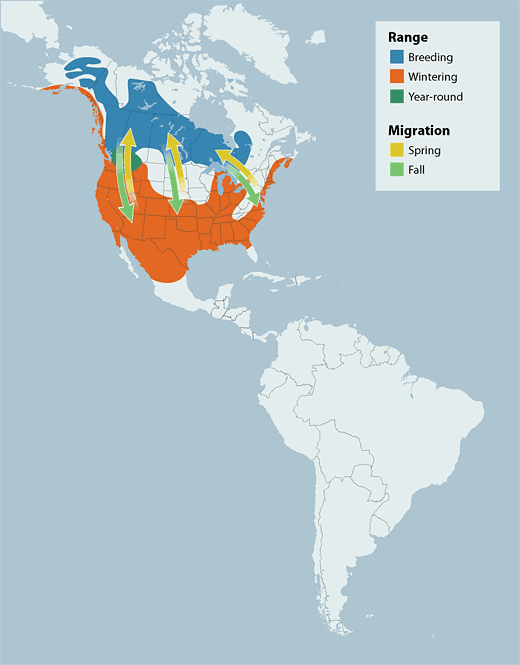
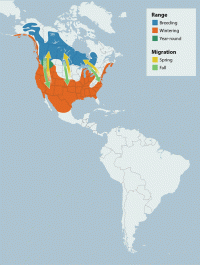
During the breeding season, the Bufflehead is found primarily within the boreal forest. where it nests in tree cavities withinlarge diameter poplar and aspen trees near small permanent freshwater ponds. During migration and in winter, the species frequents inland lakes and rivers but occurs in highest numbers in sheltered saltwater bays and coves along the Atlantic and Pacific coasts.
Range/Migration
The main migration to wintering areas begins in late October. Buffleheads travel and generally remain in small flocks of 5-10 birds, but can occasionally gather into groups of as many as 50 and, in fall, flocks of up to 500 birds have been recorded. The majority of the population winters on the Atlantic coast, from southern Newfoundland to southern Florida; and on the Pacific coast, from the northern tip of the Aleutian Islands to Mexico.
Breeding
Buffleheads have an extensive breeding range, with particularly high densities across the boreal regions of British Columbia, Alberta and Saskatchewan, and the sub-arctic deltas including the Athabasca and Slave River parklands. Buffleheads reach sexual maturity when they are about 2 years old. Pair bonds form during the first half of April (during spring migration) and they usually keep the same mate for years. During courtship, the male often puts on an extensive display. There are various displays he will initiate, but a common "dance" is the drake swimming with the bill up, neck stretched out, and head puffed to twice its normal size to show off its white head patch. He then might stand almost erect with his bill against his swelled breast, followed by a quick dive under the female. Throughout the display, there is much head bobbing and body movement from this energetic little duck.Buffleheads nest almost exclusively in tree cavities, and can squeeze through holes as small as 2.24 inches in diameter. The most common source of these cavities is old Northern Flicker holes that are often located 2-10 feet above the ground in poplar trees up to 200 hundred yards away from water. This eliminates most competition with other cavity nesters such as the Common Goldeneye; however, European Starlings and Northern Flickers still compete with Buffleheads for these nesting sites. Once females have successfully nested, many females will return to the same tree annually to nest.Nest initiation takes place between early May and mid May. Commonly, 10-14 eggs are laid and incubated for 28 – 33 days. Partway through incubation, the male will leave and gather with other post-breeding males for the wing molt. Buffleheads generally have high nest success, and the newly hatched young will spend 24 – 36 hours in the nest before jumping to the ground, where the hen will then lead the brood to nearby water. When ducklings are 5 – 6 weeks old, the female will leave, often before their first flight, which occurs at 50 – 55 days.
Diet/Feeding Behavior
Buffleheads feed by diving into sheltered, shallow water. Only the downy young will dabble at the surface. Buffleheads will feed in open water and along edges of emergent vegetation, preferring not to dive through emergent or dense submergent vegetation. They will commonly remain under water for 15-25 seconds with pauses of 5-10 seconds between dives. During the non-breeding season, Buffleheads dive and feed as a group. Invertebrates such as dragonflies, caddis flies, water boatmen, damselflies, mayflies, nymphs and midge larvae dominate the Bufflehead's summer diet. Buffleheads wintering in saltwater areas feed primarily on crustaceans, mollusks, and fish.
References
Anonymous. 2004. Sea duck information series. Info sheet #3 of 15. Sea Duck JointVenture
Bellrose, F.C. 1980. Ducks, geese, and swans of North America. Rev. ed. Stackpole Books, Harrisburg, PA.
Bent, A.C. 1951. Life histories of North American wild fowl. Dover Publications, New York.
Delacour, J. 1959. The waterfowl of the world. Vol. 3, Country Life Limited, London.
Gauthier, G. 1993. Bufflehead (Bucephala albeola). In The birds of North America, No. 67 (A. Poole and F. Gill, Eds.). Philadelphia: The Academy of Natural Sciences; Washington, D.C.: The American Ornithologists' Union.
Johnsgard, P.A. 1978. Ducks, geese, and swans of the world. University of Nebraska Press.
Palmer, R.S. 1976. Handbook of North American birds. New Haven and London, Yale University Press, London.
Phillips, J.C. 1986. A natural history of the ducks. Dover Publications, Inc. New York.
Todd, F.S. 1996. Natural history of the waterfowl. Ibis Publishing Company, Vista, California.
Credits
Birding content provided by National Wildlife Federation/eNature, with support from Ducks Unlimited/The Pew Charitable Trusts.