Guide to Boreal Birds
 Duck-like Birds
 This is an in-depth boreal species profile.
What is this?
This species is one of more than 30 birds selected for in-depth profiles. Find out why and see all selected boreal birds »

Overview
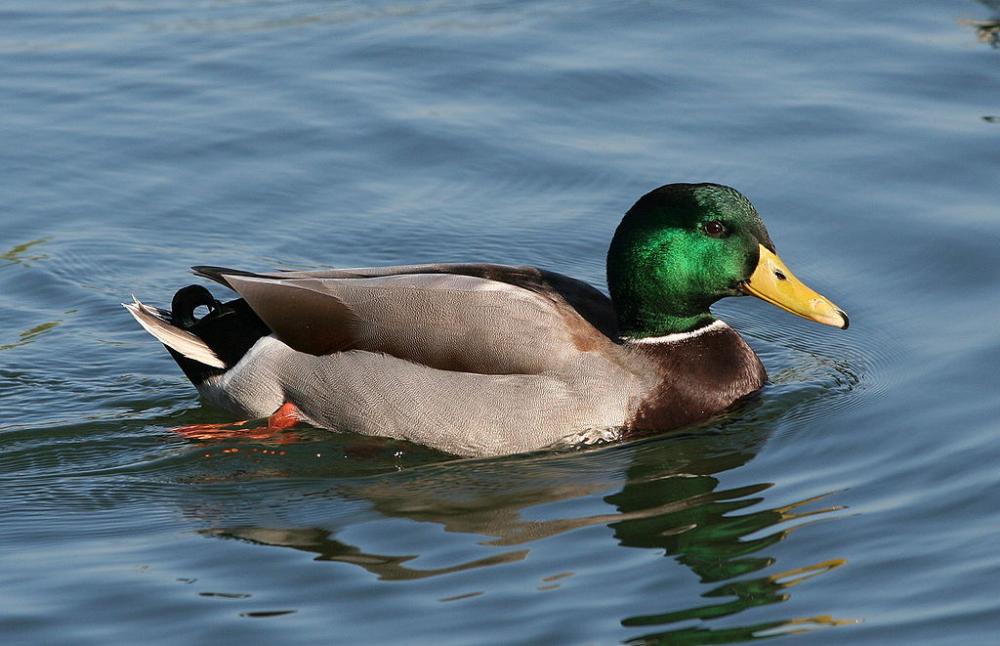
Ask someone to name a type of duck, and many people will answer readily: the Mallard. Arguably the most identified and abundant duck in North America, the Mallard is well known to many people for its colorful male and distinctive call. With its iridescent green head, chestnut breast, curly black tail-feathers, violet-blue speculum and orange feet, the breeding male mallard stands out brightly. The drabber brown hen gives a glimpse of her violet-blue speculum even when resting; her orange feet and orange and black bill (as opposed to the male's yellowish green bill) also indicate her species, and has the dark eye-line characteristic of many dabbler females. Giving voice to the stereotypical duck "quack", the Mallard is highly adaptable to humans and human-made changes, often abundant around parks, lakeshores and golf courses.
The Mallard is undoubtedly the most abundant duck in the world. Nearly 10 million live in North America, and millions more are found in Eurasia. Since the Mallard is the ancestor of the common white domestic duck, still more can be added to the total. Mallards frequently interbreed with domestic stock, producing a bewildering variety of patterns and colors. They also hybridize with wild species such as the closely related American Black Duck and even occasionally with Northern Pintails. Strong fliers, Mallards sometimes reach remote oceanic islands where isolated populations have evolved into new species. Like the Mottled Duck, these isolated populations often differ from the Mallard mainly in that they lack the colorful plumage of the male. Mallard courtship starts in the fall, and by midwinter pairs have formed. Mated pairs migrate northward together, heading for the female's place of origin. The male stays with the female until incubation is well underway, then leaves to join a flock of other males to begin the annual molt.
Description
18-27" (46-69 cm). Male has a green head, white neck ring, chestnut breast, and grayish body; inner feathers of wing (speculum) are metallic purplish blue, bordered in front and back with white. Female mottled brown with white tail and purplish-blue speculum; mottled orange and brown bill. Form in Southwest ("Mexican Duck") similar to typical female Mallard but darker; speculum blue; bill of male yellow-green; bill of female dusky orange; no white in tail.
Voice
Male utters soft, reedy notes; female, a loud quack.
Nesting
8-10 light olive-green eggs in a down-lined nest often placed some distance from water, occasionally even in a tree.
Habitat
As the most abundant duck in the northern hemisphere, the Mallard occupies most every type of habitat, including human environments. In Canada, the most important habitat for breeding Mallards is the prairies; however, in years of drought the boreal forest becomes equally as significant, as many Mallards (as with other species) will over-fly the dry prairies and head towards the lakes and streams in the boreal. Here, Mallards tend to prefer vegetated and productive wetlands with areas of open water. During migration, Mallards are often seen on flooded agricultural fields and shallow marshes and ponds. Wintering Mallards, which are able to endure cold temperatures, can occupy an area with only a small portion of open water and an available food supply, which is why they are often the most abundant duck seen during the Christmas Bird Count in Canada.
Range/Migration
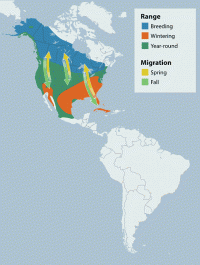
Out of all the dabblers, Mallards are one of the last species to leave the breeding grounds in the fall and have one of the longest migrations, lasting from late summer to early winter. Mallard winter range extends through most of southern Canada and the U.S., though wintering populations have been recorded as far north as the Nunavut, Yukon and Northwest Territories. Along with Northern Pintail, Mallards are the first migrants to journey north, often beating spring itself to their breeding grounds. Out of the four migration Flyways, Mallards use the Mississippi Flyway more than any other; some have even dubbed it "The Mallard Flyway" in reference to the millions of Mallards that use it each year.
Breeding
With the most widespread breeding range of any duck in North America, the Mallard is not hard to find. Chances are that group you saw crossing the street or highway was, indeed, a Mallard brood. The Mallard's breeding range includes most of North America and parts of Mexico, Europe and Asia, and has been introduced to Australia.
Pair bonding in Mallards can begin as early as August and continues until January, although some females will remain un-paired until they reach the breeding grounds. Several males will surround a female and perform courtship rituals such as shaking their bodies as they swim alongside her. Once a female is impressed, she will follow her chosen male and perform her inciting behaviour, involving ritualized head movements and characteristic calls. Looks are important; females often choose for good plumage and courtship quality, which, like most things, improve with age. While many pair copulations are initiated by mutual head-pumping, Mallards are also known for having a high number of forced-pair copulations, where a paired male will copulate with another female without the head-pumping initiation, often leading to a brood of mixed paternity.
The male will follow the female as she searches for a nesting site, which can be up to several hundred meters away from the water's edge. Mallards typically choose to nest in dense grass, low shrubs or emergent wetland vegetation; however, they will also nest in odd areas such as magpie nests, under machinery and in hay-bales. Nests are usually constructed from surrounding litter (e.g., leaves twigs, grass). Once the female begins to lay her clutch, usually one egg per day until the clutch is complete (average of 9 eggs), she will cover the eggs with vegetation as well as breast and down feathers for warmth and to conceal them from predators while she is not attending the nest. Although the female increases time spent on the nest as the number of eggs increases, true incubation does not begin until the clutch is complete. If a Mallard hen's nest is destroyed, she will often re-nest, although she will likely lay fewer eggs because of depleted energy reserves. Once her ducklings have hatched and dried, the Mallard hen leads them to water to be reared; if the temperature is still cool, she may still brood the ducklings at night until they can maintain their own body temperatures; usually two weeks after hatch. Most males will leave when incubation begins, typically moving to large ponds where they will begin to molt into their eclipse plumage. During this phase they become virtually identical to the drab female; only the yellowish-green bill identifies his sex. The males will remain this way until fall, when they will return to their breeding plumage in preparation for fall migration and another breeding season. Females will typically remain with their young until they can fly, often undergoing their molt while rearing their brood.
Diet/Feeding Behavior
Mallards have a very adaptive diet, foraging on whatever food is available at the time. Their diet ranges from animal foods such as insect larvae and aquatic invertebrates, eaten mostly during the breeding season, to seeds and aquatic vegetation. An opportunistic feeder, agricultural crops make up the bulk of their diet during fall migration. Mallards wintering in urban areas, however, tend to rely on the generosity of humans for food, often receiving birdseed or bread for sustenance.
As a member of the dabbling duck group, Mallards often feed by either tipping up or dabbling along the surface, capturing food and straining excess water through the lamellae (small boney tooth-like structures along the sides of its jaw). When field feeding, Mallards generally feed around sunrise and again at sunset; however, in some instances, especially during a full moon, they will feed throughout the night. They will fly up to several kilometers to reach their feeding area, generally a crop field (e.g., corn, peas, barley).
References
Bellrose, F.C. 1980. Ducks, geese, and swans of North America. Rev. ed. Stackpole Books, Harrisburg, Pennsylvania, USA.
Campbell, R.W., N.K. Dawe, I. McTaggart-Cowan, J.M. Cooper, G.W.Kaiser and M.C.E. McNall. 1990. The Birds of British Columbia. Volume 1: Nonpasserines. University of British Columbia Press, Vancouver, British Columbia, Canada.
Drilling, N., R. Titman, and F. McKinney. 2002. Mallard (Anas platyrhynchos). Number 658 in A. Poole and F. Gill, editors. The Birds of North America. The Birds of North America, Philadelphia, Pennsylvania, USA.
Mack, G.G. 2003. Variation in Mallard Home Range Size and Composition in the Prairie Parkland Region of Canada: Correlates and Consequences for Breeding Females.Thesis, University of Saskatoon, Saskatoon, Saskatchewan, Canada.
National Audubon Society. 2003. The Christmas Bird Count Historical Results [Online]. http://www.audubon.org/bird/cbc.
Semenchuk, G.P., editor. 1992. The Atlas of Breeding Birds of Alberta. Federation of Alberta Naturalists, Edmonton, Alberta, Canada.
Sibley, D. A. 2000. The Sibley Guide to Birds. Alfred A. Knopf, Inc., New York, New York, USA.
Sinclair, P.H., W.A. Nixon, C.D. Eckert and N.L. Hughes, editors. 2003. Birds of the Yukon Territory. University of British Columbia Press, Vancouver, British Columbia, Canada.
U.S. Fish and Wildlife Service. 2004. Waterfowl Population Status, 2004. U.S. Department of the Interior, Washington, D.C. USA.
Credits
Birding content provided by National Wildlife Federation/eNature, with support from Ducks Unlimited/The Pew Charitable Trusts.