
Guide to Boreal Birds
 Duck-like Birds
 This is an in-depth boreal species profile.
What is this?
This species is one of more than 30 birds selected for in-depth profiles. Find out why and see all selected boreal birds »
Overview
If you have never seen an American Green-winged Teal (aka Greenwing) before, don't worry: you're not the only one. One of the most frequently under-estimated ducks on aerial surveys, this little dabbler is one of the smallest and fastest ducks there is, and with a fondness for emergent vegetation, can be very difficult to spot. Approximately the size of a pigeon and a wing beat almost as fast as a diving duck's, the Greenwing flits around like a shorebird at speeds over 70km/hr, with an entire flock moving together as one.
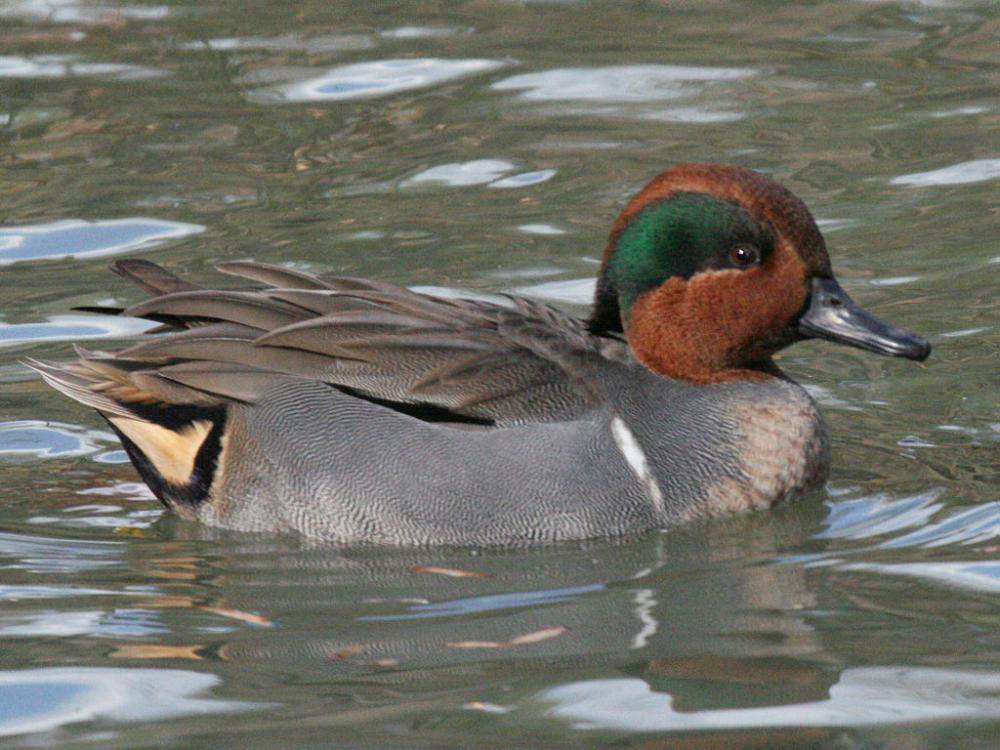
Male Green-winged Teal have a dark grey body with a russet head, and a large, dark-green eye-patch extending to its nape. Females are light mottled brown with a dark eye-line characteristic of all dabbler females. When breeding, both sexes have a white belly that is conspicuous in flight and a vibrant dark-green speculum with buff borders; often the only obvious color visible. Greenwings are an important breeder in Canada's boreal forest and the boreal transition zone.
Until recently, the North American and Eurasian forms were considered distinct species. Each year a few males-and doubtless females-of the Eurasian form turn up in North America, giving rise to speculation that somewhere in North America a few of these so-called "Common Teal" may be breeding. A hardy species, they are among the last ducks to reach their winter habitat in fall and the first to depart in spring. Flocks of Green-winged Teal fly swiftly, executing sharp turns in unison like flocks of shorebirds. When the flock settles on water, the birds often separate into small groups consisting of one female courted by several males. Eventually the female chooses a mate and the chosen male wards off other suitors. In spring the pair returns to the previous breeding place of the female, not that of the male.
Description
12-16" (30-41 cm). A small dark duck. Male has chestnut head, green ear patch, flashing green speculum, pale gray sides, and pinkish breast with a vertical white stripe down the side. Female is dark brown without distinctive markings. "Common Teal," race in Old World, has horizontal white stripe above flanks and no vertical white stripes on sides.
Voice
Clear repeated whistle. Females quack.
Nesting
10-12 whitish or pale buff eggs in a down-lined cup in tall grass, often several hundred yards from water.
Habitat
Green-winged Teal are unlike most dabblers in North America in that they prefer wooded ponds to prairie potholes. A fan of the hard work beavers do, the green-wing will often occupy beaver ponds and flowages for breeding and brood rearing, but can also be found in deciduous wooded ponds surrounded by grassy upland areas. During migration, both spring and fall, green-wings tend to choose shallow inland wetlands with abundant floating and emergent vegetation, but also use tidal mudflats more often than any other duck. Wintering Greenwings will use freshwater shallow marshes and riparian sloughs, but can also be found in saltwater estuaries and agricultural areas.
Range/Migration
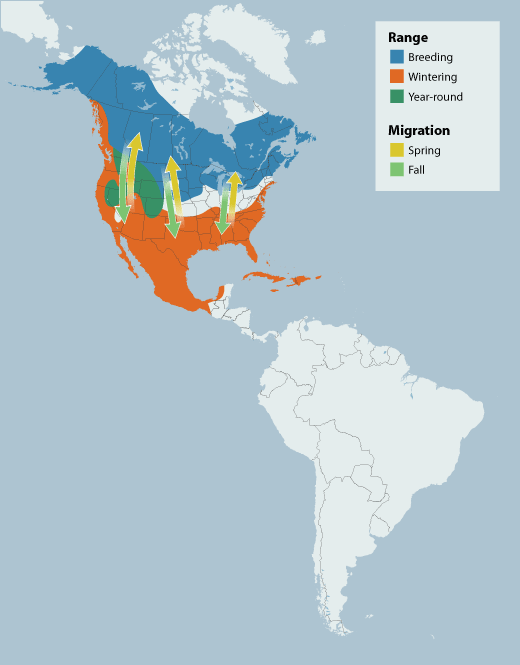
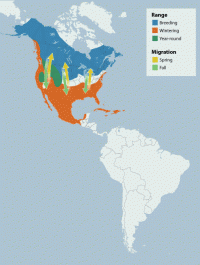
Like many dabblers, Green-winged Teal leave their northern breeding grounds in late August/early September to travel to their wintering grounds, which are as vast as their breeding grounds. Found in coastal Alaska, British Columbia, most of the U.S. States, parts of the Caribbean as well as parts of Central and South America, the Greenwing spreads far and wide throughout the Americas. Traveling in flocks larger than those of similar species, the Green-winged Teal will be on the move for weeks or months to its wintering grounds to prepare for another breeding season, and perpetuation of the species.
Breeding
Predominately a boreal and parkland breeder, the Green-winged Teal breeds in every Canadian province and territory, and a few of the more northern states in the U.S. What it lacks in size it makes up in resiliency; it is the third most abundant breeder in the Arctic, behind the American wigeon and the Northern pintail.
Greenwings form pair ponds relatively late in the season compared with other dabbling ducks, often not until late January all the way to March. Although they break their pair bond each year, Greenwings are monogamous throughout the breeding season; however, occasionally paired males will attempt forced extra-pair copulations with other females. After an elaborate sequence of displays, the female will show her approval by performing her inciting display next to her mate of choice. Once the pair is ready to mate, they will perform some reciprocated head pumping, and then will copulate on the water. Nesting females will choose an area to nest that is well concealed, with thick brush, sedge or grasses. Nesting females will choose an area to nest that is well concealed, with thick brush, sedge or grasses. She will often scrape out an area or choose a depression on the ground to construct a nest bowl by using surrounding grasses, twigs and leaves. Like other ducks, the female will also use her body feathers to aid in keeping the eggs warm, dry and concealed. The surrounding vegetation will usually form a type of canopy, concealing the nest from predators. In most cases, a female will lay one egg per day until the clutch is complete, usually 10-12 eggs. Shortly after incubation begins, the male will abandon his mate and begin to moult. During this process, he will shed his breeding plumage into a drab, hen-like plumage and remain flightless for several weeks, until growing back into his breeding plumage in preparation for fall migration and another breeding season.
The female, meanwhile, will incubate her eggs for approximately 3 weeks after her last egg is laid. Once her ducklings have hatched, she moves them to water within the first day, where the precocial young will be reared. Often ducklings are unable to maintain a high body temperature when first hatched, and the female will continue to brood during wet and cold periods.
Diet/Feeding Behavior
The Green-winged Teal's diet is very diverse, relying on insects and aquatic vegetation. An opportunistic feeder, the Greenwing varies its diet according to what is most abundant at the time. Vegetation is eaten mostly in the fall and winter, consisting mainly of seeds of grasses, sedge and emergent vegetation, as well as the occasional agricultural crop. During the breeding season, Greenwings rely more on animal matter such as aquatic insects, larvae, mollusks, crustaceans and sometimes fish eggs. A true dabbler, Greenwings often feed by tipping-up with their head under the surface of the water or collecting seeds and insects by skimming the water with its bill. More than any other duck, Greenwings will feed along mud flats, foraging for seeds, insects and mollusks.
References
Baldassarre, G.A. and E.G. Bolen. 1994. Waterfowl Ecology and Management. John Wiley & Sons, Inc., New York, New York, USA.
Bellrose, F.C. 1980. Ducks, geese, and swans of North America. Rev. ed. Stackpole Books, Harrisburg, Pennsylvania, USA.
Campbell, R.W., N.K. Dawe, I. McTaggart-Cowan, J.M. Cooper, G.W.Kaiser and M.C.E. McNall. 1990. The Birds of British Columbia. Volume 1: Nonpasserines. University of British Columbia Press, Vancouver, British Columbia, Canada.
Johnson, K. 1995. Green-winged Teal (Anas crecca). In, A. Poole and F. Gill, eds., The Birds of North America, No. 193. The Academy of Natural Sciences, Philadelphia, and The American Ornithologists' Union, Washington, D.C.
Seattle Audubon Society. 2002. BirdWeb: Green-winged Teal [online].http://www.birdweb.org/birdweb/Species.asp?id=74
Semenchuk, G.P., editor. 1992. The Atlas of Breeding Birds of Alberta. Federation of Alberta Naturalists, Edmonton, Alberta, Canada.
Sibley, D. A. 2000. The Sibley Guide to Birds. Alfred A. Knopf, Inc., New York, New York, USA.
Sinclair, P.H., W.A. Nixon, C.D. Eckert and N.L. Hughes, editors. 2003. Birds of the Yukon Territory. University of British Columbia Press, Vancouver, British Columbia, Canada.
U.S. Fish and Wildlife Service. 2004. Waterfowl Population Status, 2004. U.S. Department of the Interior, Washington, D.C. USA.
Wilkins, K.A. and M.C. Otto. 2004. Trends in Duck Breeding Populations, 1955–2004 Administrative Report. U.S. Fish and Wildlife Service, Division of Migratory Bird Management, Laurel, Maryland, USA. Unpublished Report.
Credits
Birding content provided by National Wildlife Federation/eNature, with support from Ducks Unlimited/The Pew Charitable Trusts.