Provincial and Territorial Forest Facts
Explore Canada's Boreal Forest by Province and Territory to see what makes each part of the boreal forest special.
Choose a province or territory:
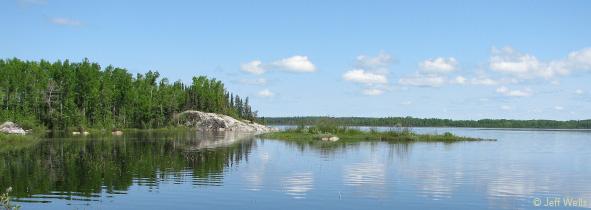
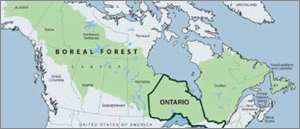
Ontario's Boreal Forest:
- is 862,000 km2 (213 million acres) in size – more than 1½ times larger than France.1
- comprises 15% of Canada's Boreal Forest.
- is home to more than 80 aboriginal communities.2 Many distinct native cultures and languages in what is today Ontario date back at least 7,000 years.3
- stores 49 billion tonnes of carbon in its soils, peat and forests – equivalent to around 245 years' worth of Canada’s GHG emissions in CO2 equivalent at 2014 levels.4
- contains the 3rd-largest wetland in the world, the Hudson Bay Lowlands, covering 25% of Ontario's land surface.
- is the breeding ground for 200 to 400 million birds of more than 250 species, including threatened species like Yellow Rail, Canada Warbler and Olive-sided Flycatcher.
- is home to the Common Loon, Ontario's provincial bird, and the Eastern White Pine, Ontario's provincial tree.
- supports approximately 5,000, or 16%, of Canada's threatened boreal Woodland caribou population.5
- features 640,000 km2 (158 million acres) of intact forest, peatland and wetland habitat free from industrial development, making up nearly 75% of the province's boreal region.6
- is home to more than 200 sensitive species of animals – including Polar bear, wolverine and caribou.
1 Canadian Boreal Initiative. 2003. Canada's Boreal Region.
2 Aboriginal Canada Portal (www.aboriginalcanada.gc.ca), and Global Forest Watch.
3 Benke, A., and Cushing, C. Rivers of North America. 2005.
4 Tarnocai, C. and Lacelle, B. 1996. Soil Organic Carbon Digital Database of Canada. Eastern Cereal and Oilseed Research Center, Research Branch, Agriculture and Agri-Food Canada, Ottawa, Canada.
5 Environment Canada. 2008. Scientic Review for the Identication of Critical Habitat for Woodland Caribou (Rangifer tarandus caribou), Boreal Population, in Canada. August 2008.
6 Global Forest Watch Canada. 2009. Canada's Forest Landscape Fragments: A Second Approximation.