Boreal Songbird Initiative : Reports & Other Publications
SEARCH SITE 


Oiled Bird Deaths Mar Canada’s Energy Lobbying Efforts

Is Canadian Oil Industry Ducking the Truth?

May 2, 2008

Oiled ducks, reminiscent
of the Exxon Valdez spill,
are treated after landing
in massive, toxic ponds in
Alberta’s tar sands this
week on the heels of a PR
blitz by Alberta officials
to tout its strong
environmental record.
Seattle, WA – The deaths of 500 migrating ducks which landed on a toxic tailings pond in Canada’s Tar Sands in the heart of Canada’s Boreal Forest have created a major international uproar. Toxic tailings ponds are just one of the many extreme environmental hazards at the enormous unconventional oil site in Northern Canada. The bird deaths come on the heels of a visit by an Alberta energy minister who toured Washington D.C. to promote the region’s environmental record while the province kicks off a $25 million public relations campaign to counter widespread reports of the tar sands high carbon emissions, water pollution, wildlife impacts, and cancer rates in downstream aboriginal villages.

Environmentalists are concerned that these waterfowl deaths appear to be business as usual --- and that they underscore a much bigger problem for billions of birds who call Canada’s Boreal Forest home. While the oil industry giant, Syncrude, where these deaths took place, issued a statement claiming this was the first large scale bird death in 30 years of operation, Dr. Jeff Wells, Sr. Scientist for the Boreal Songbird Initiative and a visiting fellow from Cornell University says, “There’s a long documented history of bird deaths in tailing ponds.”

He points to research that says:

-At least 15 species of waterfowl have already been documented as having been killed on Syncrude Tar Sands tailings ponds along with an amazing 22 species of non-waterfowl.
-Research at tailings ponds in the late 1970\'s based on once a week surveys of two Syncrude tailings ponds observed at least 100-300 birds killed annually. Since this was based only on birds observed floating or on the sides of the ponds once a week there was clearly a larger number of birds that sunk or were unobservable so these numbers represent a minimum mortality from only two tailings ponds.
-At single tailings pond sites, research has documented tens of thousands of waterfowl and other wetland-dependent birds migrating over in periods of weeks during spring and fall migration.

-Based on research at the Alberta tar sands tailings ponds it is well documented that birds are most likely to land on the ponds at night, under weather conditions that restrict visiblity and when surrounding natural lakes and ponds are frozen under such conditions there is a very high risk of large numbers of casualties because waterfowl and shorebirds and other wetland dependent birds normally travel in flocks that can regularly number into the hundreds and sometimes into the thousands or tens of thousands. The conditions under which these large mortality events are likely to occur are also periods when it is unlikely that the ponds are monitored in order to observe mortality events. Because of this it is highly likely that mortality events like this may have occurred more frequently than reported.

Dr. Jeff Wells adds: “While this is truly a sad event, these deaths are a drop in the bucket, should the Tar Sands expand as planned. Over the next twenty years, pristine boreal forest bird habitat will be destroyed, leading to bird declines in the millions.”

The spotlight from the ‘dead ducks’ story is not happy news for multinational oil companies, investing billions of dollars in the Tar Sands nor the Alberta government and its political supporters because it focuses attention during a PR blitz by Alberta officials who were in Washington D.C. trying to stop any U.S. law that might prevent Canada from exporting its high-carbon oil sand products – including a lobbying effort to put a wrench in 526 of the Energy Security and Independence Act of 2007. Section 526 addresses concerns about spending taxpayer dollars to develop alternative fuel sources that make global warming worse – such as tar sands, liquid coal and oil shale. This provision bars federal agencies from entering into contracts to procure alternative (including unconventional and synthetic) transportation fuels with greater lifecycle greenhouse gas emissions than conventional fuel. The country is also facing a renewed barrage of questions for its plan to spend $25-million on a public-relations campaign designed partly to dispel myths about the oil sands environmental issues.

The recent duck deaths are both a graphic example of the inadequacy of the regulatory framework in Alberta on health and environmental issues and also the tip of the iceberg in terms of the larger ramifications of the destruction that is happening in the Tar Sands and Canada’s Boreal Forest, America’s Bird Nursery and one of the largest forest and wetland ecosystems on the planet, to feed America’s energy appetite.

###

Contacts:
Jeff Wells, PhD Sr. Scientist Boreal Songbird Initiative 207 458 8492; jeffwells@borealbirds.org

Lisa McCrummen Boreal Songbird Initiative, (206) 321 9461, lisa@borealbirds.org


Tar Sands/Bird Impact Background:
Tar Sands oil is the world’s most harmful type of oil for the atmosphere, emitting high volumes of greenhouse gases during development, which contribute to global warming, as well as other pollutants. Tar Sands projects are the largest contributor to greenhouse gas emissions growth in Canada. By 2015, the Tar Sands are expected to emit more greenhouse gases than the nation of Denmark (pop. 5.4 million). And this expansion will take place by destroying some of Canada’s Boreal Forest, one of the largest forest wetland ecosystems left on the planet, which acts as a shield against global warming by locking carbon in its soils. This globally important forest also acts as the nesting grounds for some 5 billion North American birds, along with grizzly bear, wolf, caribou and other wildlife.

This region, part of Canada’s Boreal Forest, is one of the largest flyways in North American for waterfowl and shorebirds with well over half a million wetland dependent bird flying through and over the tar sands region every spring and fall. For several species or subspecies, a huge proportion (sometimes 80-100%) of the world population flies right over the region. Many species of high conservation concern have been documented passing over the tar sands region including Whooping Crane, Lesser Scaup (a species that has declined by 50-75%--and that was one of the most commonly observed casualties in some of Sycrudes tailings ponds as documented in a late 1970\'s research project), scoters (collectively have dropped by as much as 70%), Lesser Yellowlegs (declines of more than 50% and a documented tailings pond casualty) , and Short-billed Dowitcher (declines of more than 50%).

Web Resources:

Boreal and Tar Sands:
http://www.borealbirds.org/tarsands.shtml

What Are Boreal Birds:
http://www.saveourborealbirds.org/birds.html

Save Our Boreal Birds Petition:
http://www.saveourborealbirds.org/sign.html

Recent News Articles on the death of 500 birds in the Syncrude Tailing pond:
http://www.borealbirds.org/news_pages/news_list.php
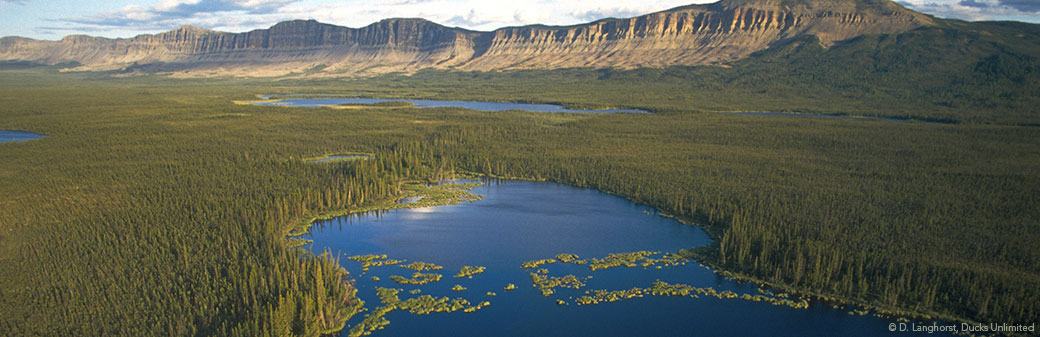
Banner photo credit: Northern Images, by Wayne Sawchuck
Jennings Lake in northern BC


FAIR USE NOTICE:
This site contains copyrighted material the use of which has not always been specifically authorized by the copyright owner. We are making such material available in our efforts to advance understanding of issues of environmental and humanitarian significance. We believe this constitutes a 'fair use' of any such copyrighted material as provided for in section 107 of the US Copyright Law. In accordance with Title 17 U.S.C. Section 107, the material on this site is distributed without profit to those who have expressed a prior interest in receiving the included information for research and educational purposes. For more information go to: http://www.law.cornell.edu/uscode/17/107.shtml. If you wish to use copyrighted material from this site for purposes of your own that go beyond 'fair use', you must obtain permission from the copyright owner.


info@borealbirds.org | 206.956.9040 | Newsletter UnsubscribeCopyright © 2007 Boreal Songbird Initiative