
Guide to Boreal Birds
 Long-legged Waders
 This is an in-depth boreal species profile.
What is this?
This species is one of more than 30 birds selected for in-depth profiles. Find out why and see all selected boreal birds »
Overview
One of our most spectacular birds, the Whooping Crane stands nearly 5 feet tall and has a wingspan of more than 7 feet. Stately, majestic, and charismatic, the Whooping Crane is a familiar symbol of the potential success of cooperative, international efforts to protect migratory species and of conservation laws such as the Migratory Bird Treaty Act and the U.S. Endangered Species Act. It is inarguably the most intensively managed and monitored boreal bird; every single individual is known, and usually its whereabouts as well. The Wood Buffalo/Aransas flock migrates 2,500 miles each way between its nesting grounds and its wintering grounds. It nests in impenetrable muskeg wilderness and winters in salt marshes. The species has been brought back from the brink of extinction through a combination of habitat protection, hunting control, captive breeding, and reintroductions and, though its numbers are still just a tiny fraction of what they once were, its future now seems relatively secure.
Description
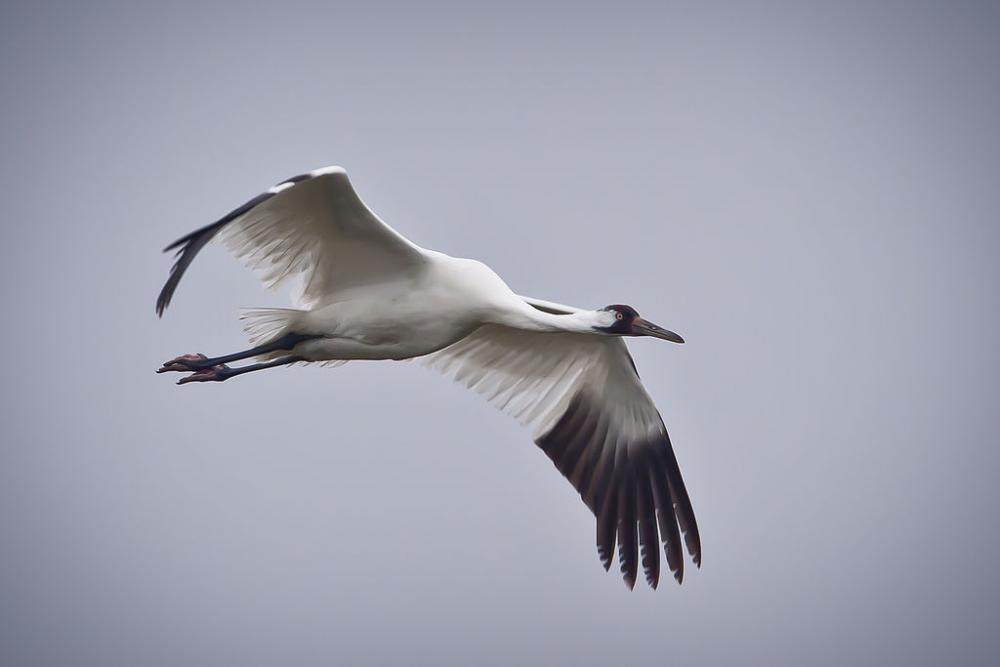
45-50" (1.1-1.3 m). W. 7' 6" (2.3 m). A very large crane, pure white with black wing tips, red on forehead and cheeks. Young birds similar, but strongly tinged with brown.
Voice
A trumpet-like call that can be heard for several miles.
Nesting
2 buff eggs, blotched with brown, on a mound of marsh vegetation.
Habitat
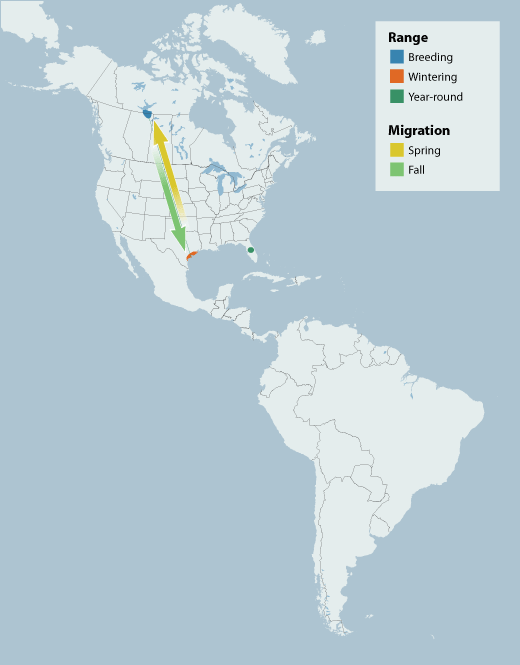
Historically, the Whooping Crane nested primarily in prairie marshes and in aspen parkland and boreal wetlands. The only surviving self-sustaining migratory population nests in Wood Buffalo National Park in Northern Alberta. The breeding grounds is an area of boreal spruce, tamarack, and willow forest growing on narrow ridges interspersed with shallow, bulrush-vegetated potholes. This population uses croplands and shallow, inland wetlands en route to its wintering grounds, where it uses estuarine marshes, shallow bays, and tidal flats in Texas at the Aransas National Wildlife Refuge.
Range/Migration
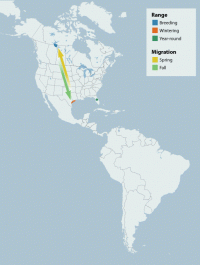
In historic times there were both migratory and sedentary populations of this species. The surviving population migrates from Wood Buffalo National Park (when?) in northwest Canada first to southern Saskatchewan, where the birds rest and feed for several weeks. They then quickly travel down a narrow corridor, roughly along the 1000-m contour line, through Montana and the Dakotas, Nebraska, Kansas, and Oklahoma to the central Texas coast in the vicinity of Aransas National Wildlife Refuge for the winter. The northward route in spring is much the same. Occasional birds show up in adjacent states and some, mostly sub-adults, summer south of the winter grounds. Experienced birds take about 50 days to migrate south but only 10-11 days to migrate north.
Breeding
As with other cranes, the Whooping Crane has a low reproductive rate compared to most birds. This has contributed to its slow recovery. The birds begin pair bonding during their second or third winter; the process may take up to three winters while the birds associate in flocks of sub-adults. The birds remain paired until one dies, after which the other usually re-mates quickly. Pair bonding, which is repeated annually, consists of walking, calling, and dancing in unison; the dance includes spectacular vertical leaps with neck arched and wings flapping. Breeding usually begins at four years of age. Experienced pairs arrive on the breeding grounds in and around Wood Buffalo National Park, on the border of Alberta and the Northwest Territories, in late April, returning to their previous territories, which they defend vigorously against young pairs arriving later. The nest is a heap of vegetation with a shallow depression on top in which two eggs are laid. Both birds incubate, primarily the male in daytime and the female at night. The precocial young hatch in about a month and are brooded at night and during bad weather for several weeks, initially in the nest but subsequently elsewhere within the territory. The young are fed entirely by the parents at first and gradually learn to feed for themselves, though they continue to beg for months afterward. The chicks can fly well by about three months of age and reach adult size at about eight months. They migrate south with their parents the first time and remain with them through the first winter, usually returning with them to the breeding grounds. Young birds usually spend their first few summers near their natal area before beginning to breed, and migrate and winter together.
Diet/Feeding Behavior
Like most cranes (and many other birds), the Whooping Crane is omnivorous, its diet varying seasonally. It tends to be primarily carnivorous in the breeding season, eating a broad range of small, aquatic vertebrates and invertebrates along with a few tubers and berries. On migration, it consumes more vegetable matter such as tubers and waste grains. The winter diet is primarily coastal invertebrates, especially crabs and clams, supplemented with upland animals and acorns obtained from flooded or burned fields. It uses a variety of techniques, including plucking, probing, and stabbing, to procure food items; one study recognized 12 distinct feeding behaviors.
References
Allen, R. P. 1952. The Whooping Crane. Natl. Audubon Soc. Resour. Rept. 3, New York.
Allen, R. P. 1956. A report on the Whooping Cranes' northern breeding grounds. Natl. Audubon Soc. Suppl. Resour. Rept. 3, New York.
Armbruster, M. J. 1990. Characterization of habitat used by Whooping Cranes during migration. Biolog. Rept. 90(4):1-16.
Bishop, M. A., and D. R. Blankinship. 1982. Dynamics of subadult flocks of Whooping Cranes at Aransas National Wildlife Refuge, Texas, 1978-1981. Pp. 180-189 in Proc. 1981 internatl. crane workshop (J. C. Lewis, ed.). Natl. Audubon Soc., Tavernier, FL.
Ellis, D. H., G. W. Archibald, S. R. Swengel, and C. B. Kepler. 1991. Compendium of crane behavior. Part 1: individual (nonsocial) behavior. Pp 225-234 in Proc. 1987 internatl. Crane workshop (J. Harris, ed.). Internatl. Crane Found., Baraboo, WI.
Lewis, J. C. 1995. Whooping Crane (Grus americana). In The Birds of North America, No. 153 (A. Poole and F. Gill, eds.). The Academy of Natural Sciences, Philadelphia, and The American Ornithologists' Union, Washington, D.C.
U.S. Fish & Wildlife Service website: http://www.fws.gov/refuge/Quivira/wildlife_and_habitat/whooping_crane.html
Whooping Crane Conservation Association website: http://www.whoopingcrane.com
Credits
Birding content provided by National Wildlife Federation/eNature, with support from Ducks Unlimited/The Pew Charitable Trusts.